
AI Makes Things Faster. Judgement Makes Them Better.

A few years ago, if you asked managers what slowed decisions down, most would point to information.
The report wasn't ready yet.
The analysis wasn't complete.
The data still needed cleaning.
Someone was still preparing the presentation.
The assumption seemed perfectly reasonable at the time. If organisations could get information faster, they could make better decisions.
In many ways, the last twenty years of business technology have been built around that belief. We invested in dashboards, reporting systems, analytics teams, business intelligence platforms, and digital transformation initiatives because we wanted information to move faster through organisations and reach decision-makers sooner.
Then AI arrived.
Almost overnight, tasks that once took hours began taking minutes.
Reports could be summarised instantly.
Customer feedback could be analysed in seconds.
Presentations could be drafted before a coffee got cold.
Questions that previously required an analyst could suddenly be answered on demand.
It is difficult not to be impressed.
I certainly am.
Yet the more I watch organisations adopt AI, the more I find myself questioning an assumption that many of us have carried for years.
What if information was never the hardest part?
What if the real challenge was always judgement?
That may sound like a strange question at first. After all, organisations have spent decades trying to improve the quality, availability, and accessibility of information. Surely better information must lead to better decisions.
Sometimes it does.
But most experienced leaders have probably sat through enough meetings to know that information alone rarely determines what happens next. I have seen leadership teams review the same report and arrive at completely different conclusions. I have seen departments interpret identical customer feedback in opposing ways. I have seen organisations with sophisticated reporting systems make poor decisions, while others with far less information navigated uncertainty surprisingly well.
The difference was rarely the data itself.
The difference was how people interpreted it.
Data helps us understand what is happening. Judgement helps us decide what to do about it. The more I think about AI, the more I believe it is transforming the first part dramatically while leaving the second part largely untouched.
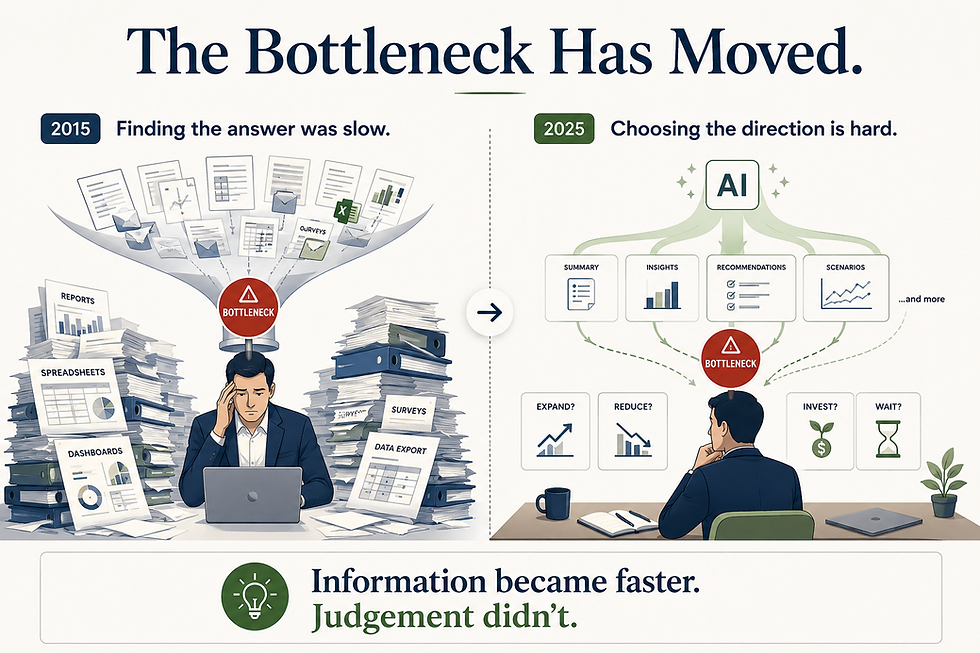
One of the reasons AI feels so transformative is that it removes effort from work that many of us never particularly enjoyed doing in the first place.
Summarising reports, organising information, preparing first drafts, searching through large volumes of documents, and identifying recurring themes are important tasks, but they are also time-consuming. If a tool can reduce eight hours of effort into twenty minutes, the productivity gains are obvious. Because those gains are visible, they naturally attract attention. People notice when a report arrives faster, when a presentation is completed sooner, and when a team can process more information with fewer resources.
What is harder to notice is whether better decisions are actually being made.
Recently, I have noticed a pattern in the way many people talk about AI. Conversations often focus on how much time has been saved, how quickly tasks can be completed, or how much more productive teams have become. These are genuine benefits and should not be dismissed.
Yet I rarely hear people talk about whether judgement is improving at the same pace.
The assumption seems to be that better information naturally leads to better decisions. The more I observe organisations working with AI, the less convinced I become that the relationship is quite that straightforward.
Take something as simple as email.
Most of us have probably asked AI to draft an email at some point. The result is often impressive. The grammar is clean, the structure is logical, and the tone usually sounds more polished than something we might have written while rushing between meetings.
Yet many of us have also experienced the strange moment when a perfectly written email somehow fails to achieve its purpose. The recipient misunderstands the message, questions come back that we thought we had already addressed, and a conversation that was supposed to become simpler somehow becomes more complicated.
The email was well written.
The judgement behind it was incomplete.
Communication was never simply a writing problem. It was a judgement problem. Understanding the audience, anticipating concerns, deciding what to emphasise and what to leave out, these decisions still belong to us.
AI can help us write faster.
It cannot automatically help us think better.
And that distinction feels increasingly important.
When Answers Become Easier
One of the unintended consequences of AI is that it reduces the amount of friction between a question and an answer.
For most of human history, answers were expensive. They required effort, time, expertise, and often a fair amount of patience. If you wanted to understand a problem, you had to gather information, speak to people, review reports, compare perspectives, and work through uncertainty before arriving at a conclusion.
The process was not always enjoyable.
But it did create something valuable.
It created space to think.
The more I reflect on how organisations are adopting AI, the more I wonder whether that space was doing more work than we realised.
Today, many answers arrive almost instantly. Ask AI to summarise a report, analyse customer feedback, compare competitors, identify trends, or suggest recommendations, and a response appears within seconds.
Yet I sometimes wonder whether we are starting to confuse the speed of an answer with the quality of our understanding. Because understanding and answers are not the same thing.
An answer tells us what might be true.
Understanding helps us decide what matters.
The difference may seem subtle, but I suspect it is becoming one of the most important distinctions organisations will need to make in the years ahead.
Years ago, when preparing for an important meeting, teams often spent days gathering information. Reports were reviewed. Assumptions were challenged. Different viewpoints were debated. Not because people enjoyed the process, but because uncertainty demanded it.
Today, some of that effort can be compressed into minutes. The efficiency gains are remarkable, but the thinking still needs to happen.
And that is where I believe many organisations may be facing a new challenge. We have become very good at accelerating the journey from question to answer. We are still learning how to preserve the quality of thinking that used to happen in between.

The Difference Between Information And Judgement
The more I think about it, the more I realise that many business decisions were never information problems to begin with.
Consider hiring.
Most organisations would gladly use AI to help screen hundreds of resumes. It is difficult to imagine many hiring managers wanting to return to manually reviewing every application. AI can identify patterns, highlight relevant experience, and help narrow the field far more efficiently than most human teams.
That is a genuine advantage.
But once the shortlist appears, something interesting happens.
The decision becomes difficult again.
Which candidate can handle ambiguity? Which person has the potential to grow into a future leadership role? Who will complement the existing team rather than simply replicate it? Who will thrive in this particular culture?
Those questions rarely have perfect answers because they involve judgement, experience, intuition, and context in ways that no spreadsheet can fully capture.
The information helps.
The judgement decides.
I have seen similar situations play out in strategy discussions. A market looks attractive, the growth projections are positive, customer demand appears strong, and competitive analysis suggests an opportunity.
Everything points in the same direction.
And yet experienced leaders often hesitate.
Not because they disagree with the data.
But because they understand that the data is only part of the picture.
Operational realities matter, regulatory environments matter, timing matters, culture matters, and execution matters.
The information may be accurate.
The decision may still be wrong.
Because information and judgement are not the same thing.
One helps us see the road ahead.
The other helps us decide whether we should take it.
Why Responsibility Remains Human
This is why I sometimes struggle when people talk about AI as though it will eventually remove the need for human decision-making.
The more capable AI becomes, the more important judgement appears to become.
Not less.
Think about GPS navigation.
Most of us have experienced the moment when a GPS confidently recommends a route that turns out to be less than ideal. Perhaps there are roadworks ahead, local traffic conditions have changed, or someone familiar with the area immediately recognises a better option.
The GPS is not wrong. In fact, it is incredibly valuable precisely because it processes information far faster than we can. But we instinctively understand something important.
The GPS is not responsible for the journey.
We are.
The recommendation belongs to the system.
The decision belongs to the driver.
I suspect AI will increasingly occupy a similar role in organisations. It will help us process information, identify patterns, and generate options. But responsibility will continue to sit with people.
Not because the technology is limited.
But because responsibility has always been a human obligation rather than a technical capability.

A Different Kind Of Competitive Advantage
For years, organisations competed on access to information.
Those with better data, stronger reporting systems, and more capable analytical teams often held an advantage over those that did not.
That advantage is becoming increasingly accessible. The tools are spreading, the technology is becoming easier to use, and the ability to generate analysis is no longer limited to specialists.
If that trend continues, the differentiator may shift elsewhere.
I suspect it will shift toward judgement.
The differentiator will not be the ability to generate more answers, but the ability to ask better questions. It will not be the ability to move faster, but the judgement to know when slowing down creates better outcomes. It will not be the ability to automate decisions, but the ability to understand the consequences behind them.
In a world where information becomes abundant, judgement becomes scarce.
And scarce things tend to become valuable.
Closing
The rise of AI is undoubtedly changing how organisations work.
Tasks that once consumed hours now take minutes. Information that once required significant effort can now be generated on demand. Many of the barriers that slowed analysis and reporting are disappearing.
These are genuine advances, and organisations should embrace them.
Yet the more I observe how AI is being used, the more I return to a question that feels surprisingly old-fashioned.vWhat actually makes a good decision?
Technology can help us gather information, generate options, and evaluate possibilities.
But it cannot tell us what matters most.
That remains our responsibility.
Perhaps that is the real lesson hidden inside the rise of AI.
We spent years trying to remove friction between data and decisions. Now that much of that friction is disappearing, we are discovering that information was never the hardest part.
Judgement was.
Because AI may create momentum.
But judgement still creates direction.


Comments