
Three Singapores on One Little Island

Singapore is tiny.
A retiree drinking kopi in Toa Payoh, a young professional working from an Orchard Road café, and a billionaire dining at Marina Bay Sands may be separated by only a few MRT stops.
They live in the same country.
But increasingly, I wonder whether they experience the same Singapore.
Because three rather different Singapores already seem to coexist on this little island.
The Singapore of the heartlands
The first is probably still the Singapore most of us recognise.
HDB flats. Coffee shops. Markets. Clinics. Supermarkets. Community clubs. Repair shops. Parks and exercise corners.
Here, the neighbourhood is not simply where people sleep. It can provide almost everything they need.
This becomes particularly important as Singapore ages.

HDB's latest household survey found that 18.2% of HDB residents were aged 65 and above in 2023, up from 14.0% in 2018. Older towns have particularly large senior populations. Marine Parade, Central Area, Bukit Timah, Ang Mo Kio and Bukit Merah had senior shares of around 25% or more.
Singapore is already adapting.
Age Well SG, Active Ageing Centres, Community Health Posts, barrier-free access and neighbourhood upgrading increasingly allow seniors to age in place.
For an elderly resident, this makes sense.
Why travel across Singapore if food, friends, groceries, exercise and healthcare are nearby?
This is also where you can still find inexpensive coffee, affordable meals, shops that repair things rather than replace them, and businesses designed largely around everyday needs rather than experiences.
Participating HDB coffee shops, for example, still offer budget drinks around $1.20 and meals around $3.50.
For many older or lower-income Singaporeans, the heartland may increasingly become not just where they live.
It becomes their Singapore.
The Singapore of lifestyle
Take the MRT a few stops and another Singapore appears.
Orchard Road.
Marina Bay.
Trendy cafés.
Lifestyle malls.
Boutique gyms.
Restaurants.
Bubble tea and artisan tea.
Movies, pop-ups and entertainment.
Here, a coffee can easily cost $6 to $8.
A latte at Coffee Bean starts around $6.50. At Starbucks it can approach $8 depending on size and location. At Jimmy Monkey, a white coffee starts at $6.
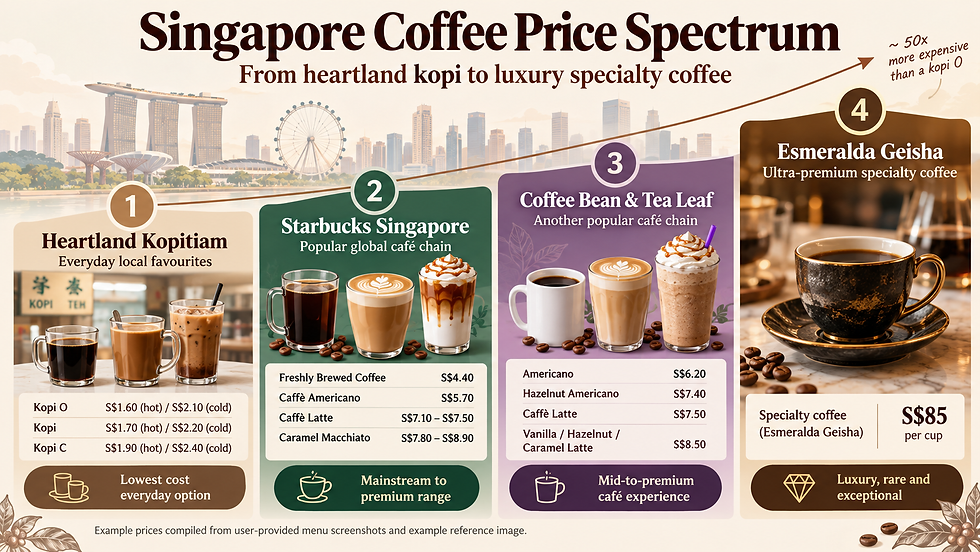
These places are not principally where people live.
They are where people spend their discretionary time and money.
Young professionals.
Teenagers supported by their parents.
Singles without children or large mortgages.
Dual-income couples.
More affluent families.
Tourists.
For them, an $8 coffee may feel expensive, but affordable. A $30 Grab trip is irritating rather than prohibitive. A $100 dinner may be a treat rather than a major financial decision.
This is Singapore as lifestyle.
And then there is Singapore as privilege
Beyond the $2 kopi and $8 latte lies another economic world.
Prime property.
Private clubs.
Luxury cars.
Fine dining.
Premium healthcare.
Frequent international travel.
Luxury brands and experiences that most Singaporeans may never encounter.
Singapore has deliberately positioned itself as a global wealth-management centre.

There were about 400 single family offices in 2020, 700 in 2021, 1,100 in 2022, 1,400 in 2023 and more than 2,000 by 2024–25. Singapore's asset-management industry reached S$6.7 trillion in assets under management in 2025.
Again, there is nothing inherently wrong with this.
Their capital supports jobs, investment, professional services and businesses.
The more interesting question is:
What happens when consumers with such vastly different spending power compete for space on the same very small island?
For now, the three Singapores coexist
And remarkably well.
Singapore has deliberately created counterweights to pure market forces.
HDB housing.
Hawker centres.
Coffee shops.
Polyclinics.
Public transport.
Parks.
Community facilities.
Affordable food programmes.
The heartlands remain highly functional places to live.
But businesses follow customers.
Landlords need rent.
Restaurants need sales.
Retailers need revenue per square foot.
If one customer will spend $2 and another $8 on coffee, businesses notice.
If one spends $10 on dinner and another $100, businesses notice that too.
That is not sinister.
It is simply how markets work.
But Singapore has one complication:
there isn't much more land.
What happens when the $8 Singapore moves into the $2 Singapore?
We already see younger estates attracting cafés, bakeries, gyms, pet businesses and lifestyle concepts that reflect the demographics living there.
Again, that is not necessarily bad.
It makes neighbourhoods more vibrant.
But it reveals something important:
Businesses change when the customers around them change.
And the process of crowding out need not be dramatic.
A traditional shop closes.
A new tenant can afford higher rent.
A coffee shop changes ownership.
A repair shop becomes a lifestyle retailer.
An inexpensive bakery becomes an artisan bakery.
Prices creep upward.
More transactions become digital.
Nobody has been evicted.
Nobody erected a barrier.
The neighbourhood remains physically accessible.
But it may become progressively less economically accessible to some of the people already living there.
And the people most affected may have the least room to manoeuvre
A young professional can adapt.
Travel farther.
Shop online.
Change jobs.
Learn another payment system.
Move neighbourhoods.
An 80-year-old resident on retirement savings has fewer options.
Their friends are nearby.
Their doctor is nearby.
They know the bus routes.
They know the shopkeepers.
Their income may be relatively fixed.
And travelling becomes harder with age.
The irony is that the neighbourhood becomes more important precisely when the resident becomes less able to leave it.
Perhaps this is another way of thinking about inequality
We normally measure inequality through income or wealth.
Perhaps another measure is:
How much of Singapore remains practically available to you?
Can you travel anywhere without worrying about transport costs?
Eat wherever you happen to be?
Participate in activities around you?
Take a taxi when your knees hurt?
Replace something when it breaks—or do you need someone nearby who can repair it?
Can you spend time somewhere without feeling that you must first buy an $8 drink?
Money does not merely buy possessions.
It buys choice, mobility, convenience and room to manoeuvre.
The island remains the same size.
But each person's Singapore can be very different.
The issue is not stopping the other Singapores from growing
Singapore should remain attractive to investment.
Successful Singaporeans should become wealthier.
Young people should enjoy cafés, restaurants and experiences.
Global businesses should want to operate here.
The danger comes only if one Singapore starts replacing another rather than existing alongside it.
When the fashionable café replaces the affordable coffee shop.
When the lifestyle store replaces the repair shop.
When neighbourhood improvement becomes neighbourhood unaffordability.
When spaces serving people with little purchasing power disappear because someone else can generate a better financial return from them.
That may be the line worth watching.
Because the heartlands provide something markets do not always measure well.
The $2 coffee shop provides more than coffee.
It provides routine.
Familiar faces.
Conversation.
Affordable food.
Somewhere to sit.
Perhaps even somebody who notices when an elderly regular suddenly stops appearing.
Its economic value per square foot may be modest.
Its social value could be enormous.
So perhaps the question is not whether there are three Singapores
They already exist.
The question is whether, twenty years from now, there will still be room for all three.
Especially the first.
For an 80-year-old who has lived in the same HDB estate for forty years, Singapore may not mean Marina Bay Sands, Orchard Road or a global financial centre.
Singapore may simply be the twenty-minute radius around their flat.
The market.
The coffee shop.
The doctor.
The park.
Their friends.
Their memories.
Perhaps one measure of Singapore's future success should therefore be remarkably simple:
As this little island becomes richer, does that twenty-minute Singapore remain affordable, familiar and theirs?
Because being priced out of Singapore does not necessarily mean being forced to leave.
Sometimes you remain in exactly the same home.
Your Singapore simply gets smaller around you.
Do these “three Singapores” reflect what you see around you — or is this framing too simplistic?
I’d be especially interested to hear how your own neighbourhood has changed over the years, and whether you think Singapore is becoming more inclusive, more stratified, or perhaps both at the same time.
Share your perspective in the comments.


Comments