
Deploying AI at Work — A Framework Built on the Most Reliable Method We Know
Why the scientific method is the right foundation for AI adoption, and what that means in practice

Most conversations about AI at work start in the wrong place.
They start with the tool.
Which model should we use? Should we try ChatGPT or Claude? Do we need to build something custom? The questions come fast, and they feel urgent. But they are the wrong questions to be asking first — because they assume the hard part is choosing the technology. It is not.
Here is a more useful question: what method do we already know for making reliable decisions under uncertainty, where the process itself tells you whether your conclusion is right — and is specifically designed not to simply agree with you?
The answer, of course, is the scientific method.
And it turns out to be exactly the right foundation for deploying AI at work.
Why the scientific method, specifically
The scientific method has one property that most management frameworks lack: it is self-correcting.
It does not just point you forward. It gives you the means to find out you were wrong — before the consequences become expensive. Every step in the process is designed to surface disconfirming evidence, not confirm what you already believe. You define the problem. You form a hypothesis. You collect data. You test. You interpret what the results actually say, not what you hoped they would say. And crucially, the method tells you when to stop.

Most organisations deploy AI the way decisions used to be made before clinical trials: based on intuition, authority, and early anecdote. Someone sees a compelling demo. A competitor announces an AI initiative. A vendor promises efficiency gains. And so the organisation proceeds — without ever asking the harder questions about whether the tool actually works for their specific context, at what error rate, and at what cost.
The scientific method is the corrective. Not because it guarantees good outcomes, but because it raises the probability of them by forcing you to test assumptions before scaling them. It is, as best we know, the most reliable method available for making informed decisions under genuine uncertainty.
FYT's AI deployment framework applies this same logic — define, hypothesise, build, test, interpret, integrate — to the specific challenge of deploying AI at work. If you have been through FYT's analytics curriculum, the underlying structure will feel familiar. That is intentional. The thinking that makes a good analyst is the same thinking that makes a responsible AI deployment.
Most of us are AI users. That is not a disadvantage.
Before getting into the framework, it helps to be honest about where most organisations actually sit.
There are broadly three levels of participation in the AI economy. At the top are AI Builders — companies like OpenAI and Anthropic that train foundation models from scratch. This requires extraordinary compute budgets, vast datasets, and deep machine learning expertise. Very few organisations belong here, and they should not try to be.
Below them are AI Integrators — companies that combine AI capabilities (text generation, voice, video synthesis) to build new products and services. Some organisations may operate at this level for specific use cases.

And then there is where most people and organisations actually operate: as AI Users — deploying off-the-shelf tools like ChatGPT, Claude, or Copilot to augment existing workflows.
This is not a consolation prize. It was never about the tool. It has always been about knowing how to use it, when to use it, and how to design systems around it that scale. The organisation that thinks most carefully about deployment will consistently outperform the one that simply bought the most impressive tool. That is the scientific method's implicit promise: rigour beats intuition, repeatedly, over time.
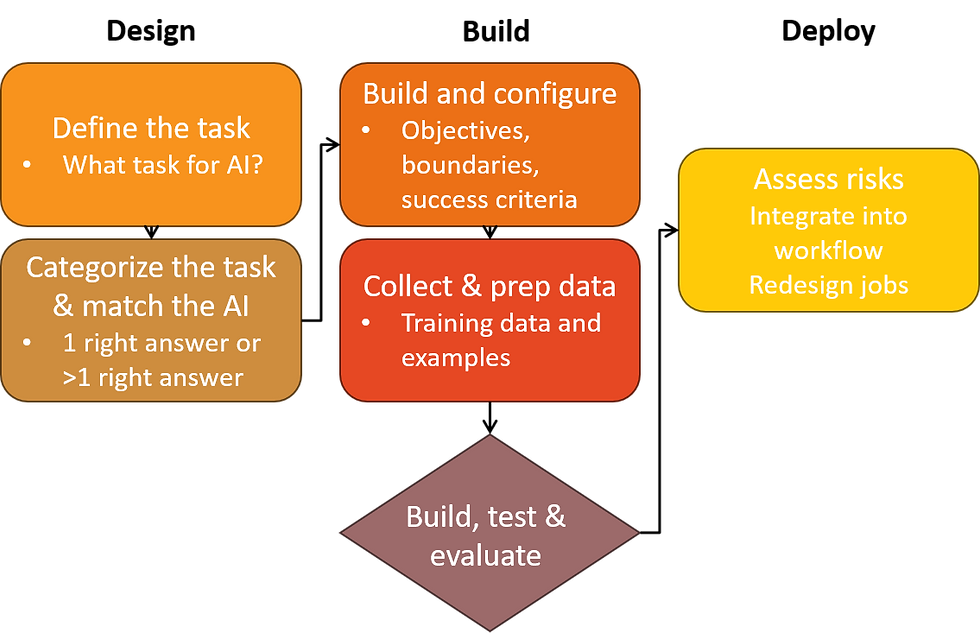
Step 1 — Define the task, not the technology
Employment exists because employers need to accomplish specific work tasks. Those tasks accumulate into roles. And it is at the level of individual tasks — not job titles, not departments — that the AI deployment question actually lives.
Work tasks generally fall into two categories. The first are tasks with one right answer: issuing a paycheck, reconciling a bank statement, categorising an expense, resetting a password. These are rule-based, deterministic, and repeatable. The second category covers tasks where there is more than one acceptable answer: responding to a client query, writing marketing copy, facilitating a workshop, drafting a policy. These involve judgement, context, and nuance.

This is the problem-definition step. Before any technology is considered, the question is simply: what tasks are we trying to automate, and what type of answer does each one require?
It is also important to be honest about limits. AI today can automate a meaningful share of routine tasks, but many others still require human judgement, contextual awareness, and accountability. Defining the task clearly is what prevents you from discovering this at the wrong moment.
Step 2 — Match the right AI to the task
Once the task is defined, the choice of AI type follows logically.
Machine learning and traditional code-based automation have long been effective for tasks with one right answer — they are reliable, consistent, and highly scalable when the rules are stable. Large language models, such as ChatGPT or Claude, are better suited to tasks where there is more than one valid response. They handle ambiguity, context, and nuance in ways that rule-based systems cannot.
This is the hypothesis step. You are not yet building anything. You are making a considered prediction: if we apply this type of AI to this type of task, here is what we expect to happen. That prediction becomes the basis for everything that follows.
Step 3 — Build and train with intention
Choosing the right type of AI is only the beginning. Even when working with readily available tools, there is real work involved in making them perform reliably.
This means defining clear objectives: what exactly should the AI accomplish, and what does good output look like? It means setting boundaries: what topics or actions should be off-limits? It means providing relevant examples or data to guide behaviour. And it means being explicit about how success will be measured.
This is the data collection and experimental design step. In science, poorly designed experiments produce unreliable results regardless of how sophisticated the equipment is. The same applies here. Vague instructions produce vague outputs. Poorly scoped tasks produce inconsistent results. The AI is only as useful as the thinking that went into directing it.
Step 4 — Test before you trust
This is where many AI deployments stall — or should. And it is where the scientific method most clearly earns its place.
Before any AI is used in a live setting, it needs to be tested rigorously. Not just for whether it can produce the right output, but for how often it does, under what conditions it fails, and what the consequences of failure look like. Practical questions to answer at this stage include: how reliably does the AI complete the task correctly? How often does it hallucinate or produce errors? What does each run cost in terms of compute? Is that cost genuinely lower than the human alternative when reliability is factored in?
This is the analysis step — and it is the step most commonly skipped. Skipping it does not save time. It defers the cost to a point where errors are harder to contain and more expensive to reverse.
Critically, this step is also where the process may tell you to stop. If test results are poor, the right response is not to press forward and hope for improvement in production. It is to return to step 1 or 2 — redefine the task, or reconsider the AI type. The scientific method's most important feature is precisely this: it is equipped to tell you when your hypothesis was wrong, rather than simply agreeing with your original intent.
Step 5 — Assess the risk before you scale
Not every AI application carries the same stakes, and the deployment model should reflect that.
For tasks where errors are inconvenient but not catastrophic — drafting a first version of a document, summarising a meeting, suggesting a reply — autonomous AI deployment may be appropriate. Speed and scale bring their own value, and the cost of the occasional mistake is manageable.
For tasks where errors could cause significant harm — financial decisions, medical recommendations, compliance-sensitive outputs, customer-facing commitments — a human-in-the-loop model is more appropriate. The AI drafts or assists; a human reviews and decides. This is slower than fully autonomous, but still meaningfully faster than a process with no AI involvement.

For the highest-risk applications, the calculus may favour human-led processes supported by AI, rather than AI processes supervised by humans. The distinction matters.
The question is not can AI do this? It almost certainly can. The question is what happens when it gets it wrong, and how often will that be acceptable? That is a risk interpretation question — and like all good interpretation, it requires human judgement, not just data.
Step 6 — Integrate, redesign, and communicate
Getting the AI to work is one thing. Getting the organisation to work with the AI is another matter entirely.
Successful deployment does not end when the tool goes live. It requires updating workflows to reflect the new division of labour between humans and machines. It requires redesigning roles so that people understand what they are now responsible for — and what they are not. It requires addressing data governance questions: what information is the AI accessing, how is it stored, and who is accountable for its outputs? Legal implications need review, particularly where AI outputs inform decisions affecting employees, customers, or third parties.
This is the communication and integration step — the moment where findings from the experiment are translated into sustainable change. In science, an insight that cannot be communicated or acted upon does not create value. The same is true here. Organisations that treat integration as an afterthought tend to find that their AI investment underperforms — not because the technology failed, but because the human and organisational systems around it were not ready.
Onboarding matters too. People need to understand not just how to use the tool, but why the workflow changed, what the AI can and cannot do, and where their judgement is still required. That last point is not trivial. When AI handles the routine, the human role shifts toward interpretation, oversight, and decisions that genuinely require contextual thinking — which is precisely what the scientific method has always depended on.
Thinking is still the differentiator
The organisations that will get the most from AI are not necessarily those with the largest budgets or the most sophisticated tools. They are the ones that think most carefully about the work — before, during, and after deployment.
That means mapping tasks honestly. Testing rigorously. Interpreting results without confirmation bias. Designing workflows that keep humans accountable where it matters. And building the capability to do this repeatedly, as AI capabilities evolve and new use cases emerge.
This is what the scientific method has always asked of us. It is what good analytics has always asked of us. And it is what responsible AI deployment asks of us now.
AI accelerates tasks. Humans interpret and decide.
The goal is not to hand over the thinking. It is to free up more space to do it well.
If your organisation is working through how to deploy AI practically and responsibly, we would be glad to help. Reach out to FYT Consulting — or subscribe to our blog for more practical content on data, AI, and decision-making.


Comments