
Singapore Is Ageing Alone: How Far Limited Data Can Take Informed Decisions
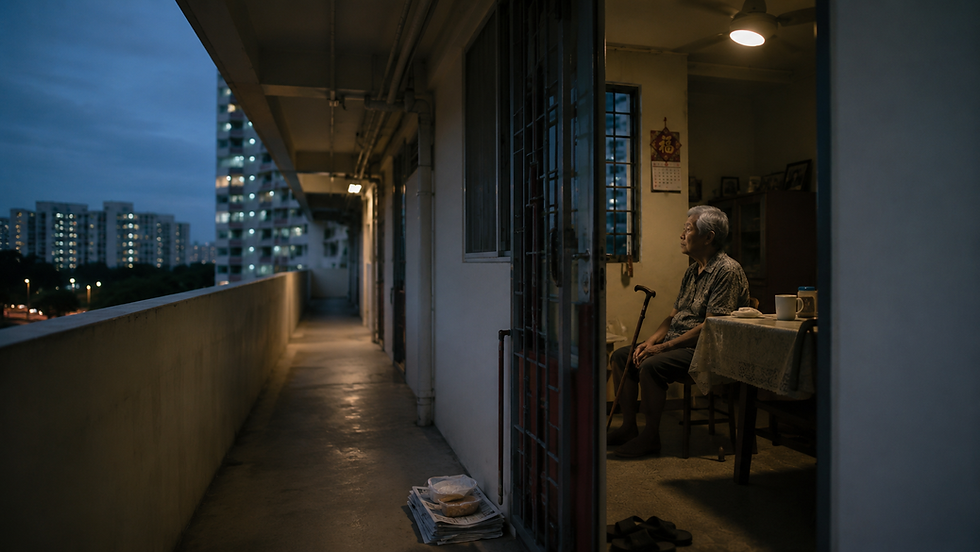
Singapore is growing older every year — that part isn't in dispute. Citizens aged 65 and above made up 20.7% of the resident population in June 2025, up from 13.1% a decade earlier, and are projected to reach almost a quarter of citizens by 2030 (Source: Population in Brief 2025). Most conversations about this shift focus on healthcare costs, retirement adequacy, and workforce planning. Fewer focus on a quieter, harder question: as more seniors live alone — never married, outliving spouses and siblings, or simply living apart from children who started smaller families of their own — how many might die without anyone noticing for days, sometimes longer? And if we can't count that directly, can Singapore's own population data at least tell us where to look first?
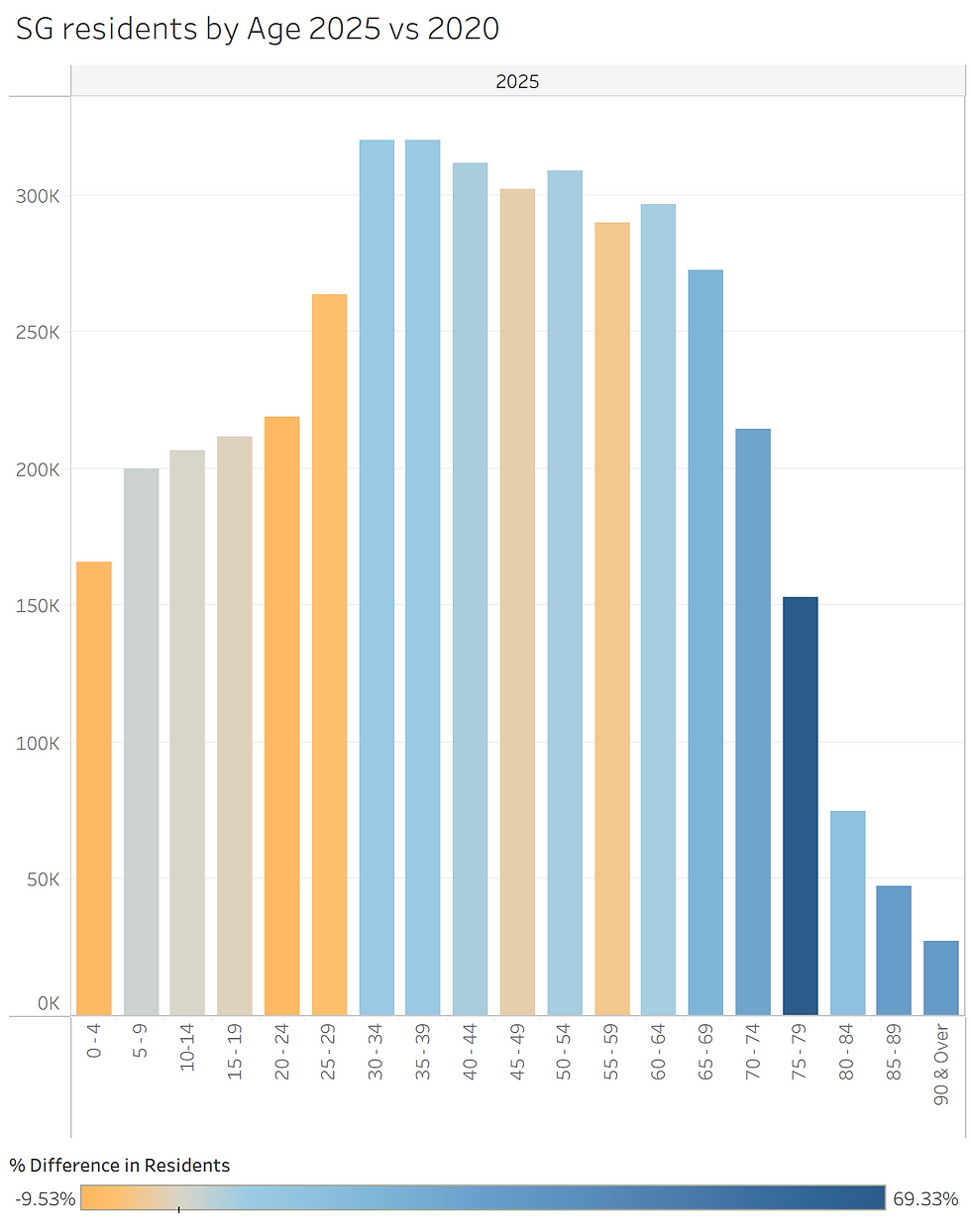
This piece is as much about that second question as about seniors dying alone specifically. There is no comprehensive dataset for this issue, and there may never be one — true of many questions organisations genuinely need answered. What follows illustrates what's still possible when the ideal data doesn't exist: building the most defensible picture you can from what's actually available, being explicit about its limits, and using it to point attention in the right direction rather than claim certainty it can't support.
The right question isn't "how many" — it's "where"
The obvious question is: how many seniors in Singapore die alone each year? It's a fair question, and one that's been asked in Parliament at least three times since 2020. Each time, the Ministry of Health has given essentially the same answer: it does not track this — not because the concern isn't real, but because "died alone, undiscovered for some time" simply isn't a category Singapore's official records keep. That leaves an incomplete picture, pieced together from news reports and community trackers rather than a comprehensive count.
So the more useful question isn't "how many, exactly" — something the data genuinely can't answer — but a more modest one: given what we know about who is ageing, who lives alone, and whose household has no other family member around, can we reasonably hypothesise which parts of Singapore carry more of this risk? And does a sample of real, reported cases point the same way?
The backdrop: an ageing population with shrinking families
Three trends are converging. The pace of ageing has picked up: the citizen 65-and-above share has grown by nearly 8 percentage points since 2015, and the number of citizens aged 80 and above has grown by roughly 60%, from 91,000 to 145,000, over the same decade (Source: Population in Brief 2025). At the same time, marriage and birth rates continue to soften: the preliminary 2025 total fertility rate of 0.87 is a fresh record low, and the 24,687 marriages registered in 2025 mark the third straight year of decline since a 2022 peak (Source: Singapore Department of Statistics). And less discussed, families themselves are getting smaller: among ever-married women aged 40–49, a proxy for a completed family, the share with just one child rose from 21.6% in 2014 to 25.1% in 2024, even as two-child families remain the most common household (Source: Ministry of Social and Family Development, Family Trends Report 2025).
None of this proves that more seniors will die alone. But it does mean the pool ageing with fewer children, fewer siblings, and fewer relatives close by is growing. Reasonable projection, not a foregone conclusion.
Building a dataset from what's actually available
There's no official register to pull from, so we built our own: a working list of individual seniors reported found dead after living alone, drawn from Mothership, The Online Citizen, and Must Share News reporting between January 2025 and mid-2026. It's a sample built from what made the news, not a census — suggestive, not comprehensive.

For context on scale, a charity called Loving Heart Multi-Service Centre keeps its own community tally, drawn from media monitoring and its own outreach network: 42 cases in 2024, 33 in 2025 (Source: Straits Times, via Asia News Network). We looked into whether that fuller tally, or the underlying case archive kept by Death Kopitiam Singapore, could be accessed directly rather than reconstructed one article at a time. A more complete, more current archive appears to exist, numbered case by case on a social media page rather than an openly accessible website, but it wasn't something we could responsibly pull into this dataset with the tools on hand. We're naming that limitation plainly: our sample is genuine, but likely understates the true count, and a fuller picture would probably require reaching out to Loving Heart or Death Kopitiam directly.
What the cases themselves show
Before turning to where these cases cluster geographically, it's worth pausing on who they actually were — because on that count alone, the sample already lines up with two of our starting assumptions. Of the 25 confirmed solo cases, an age was reported for 21; among those, the median was 71, nine in ten were 65 or older, and well over half were in their 70s or beyond. Nineteen of the 25 were also explicitly confirmed in the source reporting as having lived alone, with the remaining six consistent with it even where the article didn't spell the detail out. That's a second, more direct kind of support for the hypothesis: not just that certain planning areas look higher-risk on paper, but that the people in the actual reported cases were, individually, mostly older seniors living by themselves.
What the population data suggests about where
Using Singapore's General Household Survey 2025 data, we asked a fairly direct question: do the planning areas where these seniors were actually found dead alone line up with where the numbers say they should — more seniors, more people living alone, more smaller flats? We set Tengah aside throughout, since its "small flat, single-person household" numbers reflect a brand-new town still filling up with young families, not an ageing one.
Two things are worth saying before looking at the results. First, with only 25 cases spread across 29 planning areas, we shouldn't expect a tight match — a sample this size will always look somewhat scattered, whether or not the underlying pattern is real. Second, and more fundamentally: simply having more seniors in an area, especially seniors nearing the country's average life expectancy, means more deaths overall there, of any kind — dying alone or otherwise. Some of any "match" we find between the population data and the case locations may just reflect more older people living, and eventually dying, in a place, rather than something distinctively risky about how isolated they are there.

One factor speaks directly to this: not just the share of residents aged 65 and above in a planning area, but the absolute number living there. Bedok is the clearest illustration: its 65-and-above share isn't unusually high compared with other mature estates, but with close to 275,000 residents it is home to more people that age in raw numbers than almost anywhere else in Singapore — and it had the most reported cases of any planning area in our sample. That fits the point above: a large number of older residents produces a large number of deaths, some of which go undiscovered for a time, substantially as a matter of scale.
Combining share of seniors, absolute number of seniors, share living alone, and share in smaller flats points to a shortlist of higher-risk areas: Bukit Merah, Ang Mo Kio, Kallang, Outram, Toa Payoh, Bedok, and Geylang. Outram deserves a caveat of its own, much like Tengah: it's a small, atypical estate (roughly 17,000 residents, a fraction of most other planning areas), so a couple of cases either way swing its numbers disproportionately, and it should be read with more caution than the rest of the list. Checked against our sample, this seven-area shortlist accounts for just under half of all reported cases, while those same seven areas hold less than a quarter of Singapore's resident population. Bedok recorded four cases, the most of any planning area; Bukit Merah recorded three. Kallang, though it ranks third on this list, shows just one — a reminder that a population-based shortlist is a starting hypothesis, not a guarantee.
Sembawang and Hougang sit outside that shortlist as the sample's two clearest outliers. Sembawang has one of the lowest 65-and-above shares of any planning area, yet recorded three cases. Hougang recorded three as well, despite ranking only middling on our combined score. More strikingly, two of Hougang's three cases were found in the same block, just three days apart. Are those two cases connected in some way, or simply a coincidence of timing in a large, dense estate? Given how small this sample is, we cannot confirm either explanation, and we'd rather say so plainly than lean toward whichever answer sounds more satisfying.
The bigger question underneath all of this isn't really about any one estate. It's whether the geographic pattern of seniors living alone — and, where the data allows it, without another family member nearby — is reliable enough to help social and emergency services direct genuinely limited resources to where they're needed most. That's a higher bar than "an interesting shortlist," and on the evidence here, we're not there yet. But the number of seniors living alone is rising by design, not by surprise, as Singapore's population continues to age — so it's a question worth returning to as the data improves, not one to shelve simply because it isn't fully answerable today.
The broader lesson: informed decisions don't require perfect data
What this really illustrates isn't a finding about Bukit Merah or Bedok specifically — it's what's possible when the data you need doesn't exist, and how to build something useful anyway without overstating it. Singapore doesn't track seniors who die alone, and it may be some time before it does. That doesn't make the population survey data sitting in SingStat's tables useless in the meantime. Used carefully — sources named, gaps stated plainly, limits respected — it can still create a foundation for informed decision-making: not a definitive answer, but a sense of where a closer look might matter most.
This discipline matters well beyond eldercare. When the numbers you want aren't available, the temptation is either to abandon data entirely or to overstate what a smaller, imperfect proxy can tell you. The more useful habit is to build the best picture the data allows, say plainly what it can and can't support, and let decisions be informed without mistaking that picture for certainty. A good analysis also rarely ends with a tidy answer — often its real value is the better question it leaves behind, Sembawang and Hougang being the cases in point here.
Where this leaves us
So: does Singapore's ageing population, its shrinking families, and its rising share of people living alone mean more seniors will die alone in the years ahead? On the evidence available — official numbers that don't exist, a charity's tally that's risen sharply, and a sample that skews older and largely alone — it's a reasonable projection, not a proven fact. Whether the shortlist above holds up, and whether it can ever be sharp enough to guide where help is directed, will depend on better data than any of us currently have. Until then, this is what informed decision-making looks like in its absence.
If you enjoy practical analytics content like this, consider subscribing for more articles on data analytics, AI, visualisation, decision science, and data storytelling. Subscribe here
If you or your team are looking to build practical data and AI capabilities, feel free to reach out to us at FYT Consulting. Contact us


Comments