
Stop Guessing. Start Knowing.
Why More Data Still Doesn’t Guarantee Better Decisions

The Quiet Frustration Inside Many Organisations
Over the past decade, organisations have invested heavily in becoming more data-driven. Dashboards became more sophisticated, reporting became increasingly automated, and teams gained access to more information than ever before. Entire functions were built around analytics, business intelligence, reporting, and digital transformation.
On paper, this should have made decision-making easier. Yet many organisations quietly discovered the opposite.
Despite having more visibility than ever before, many teams still struggle to align, prioritise, and move decisively. Meetings become filled with charts, KPIs, trend lines, dashboards, and performance summaries, yet the conversations that follow often feel strangely repetitive.
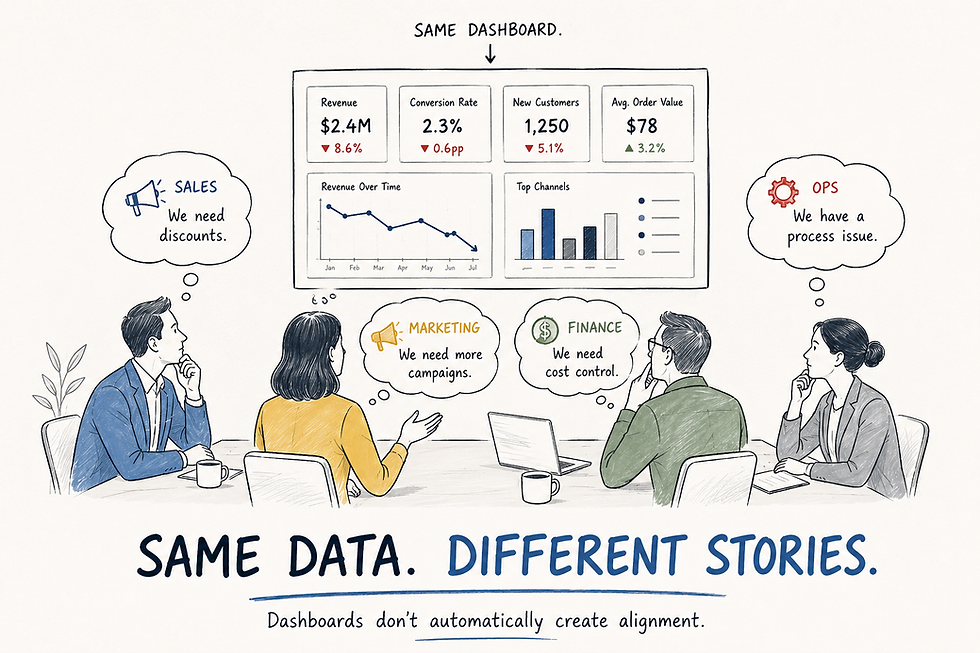
One stakeholder sees a pricing problem. Another believes marketing is underperforming. A third argues operations is the real issue. Someone else believes the problem is customer retention.
Everyone is looking at the same dashboard. Yet everyone is walking away with a different interpretation.
I have seen meetings where a single dashboard triggered four completely different conclusions within minutes. Sales believed pricing was the issue. Marketing argued lead quality had weakened. Operations pointed to fulfilment delays. Finance focused on shrinking margins.
Nobody was ignoring the data.
They were simply interpreting it through different lenses. That is because dashboards do not eliminate interpretation. They simply make interpretation visible.
The Misconception About Data Objectivity
One of the biggest misconceptions in analytics is the belief that data naturally creates objectivity. In reality, data still passes through human judgement, organisational priorities, personal incentives, operational realities, and business assumptions. A dashboard may show declining conversion rates or slowing growth, but it cannot automatically tell an organisation what matters most, what trade-offs are acceptable, or what action should be taken.
This is where many organisations unknowingly hit a wall.
They invest heavily in reporting capability but spend far less time building analytical thinking capability.
As a result, teams become extremely good at producing information without necessarily becoming better at interpreting it.
Over time, this creates a subtle but important organisational problem. Dashboards multiply. Discussions become longer. Reporting becomes more detailed. Yet decision-making itself often becomes slower and more fragmented.
Ironically, many organisations become more informed while feeling less certain. That tension matters because business leaders are rarely rewarded for collecting information. They are rewarded for making sound decisions under uncertainty. And uncertainty never disappears completely.
Good analytics does not eliminate uncertainty. It reduces it enough for organisations to move forward with greater confidence.
When Visibility Starts Working Against Focus
The issue is rarely the absence of data. More often, the issue is the absence of clarity.
Many organisations assume that visibility automatically creates understanding, but these are not the same thing. Access to information does not guarantee alignment, confidence, or focus. In fact, too much information can sometimes weaken all three.
This is especially common in environments where every stakeholder wants another metric added, another breakdown included, or another dashboard created “just in case.” Eventually, teams become surrounded by information while struggling to identify what truly deserves attention.
In some organisations, dashboards quietly become a form of organisational comfort. Adding more metrics feels productive and data-driven, even when nobody is entirely sure which numbers genuinely influence decisions anymore.
The result is often ironic: Greater visibility, but weaker focus. I have also seen situations where teams spend weeks refining dashboard layouts, colours, drill-downs, and filters, only for the final presentation to end with the same unresolved question:
“So what exactly should we do next?”
That moment reveals something important. The organisation does not actually have a dashboard problem.
It has a decision-making problem.
At that point, analytics risks becoming reporting theatre. Interesting to review. Difficult to act on.

The Questions Strong Analytics Teams Ask Earlier
Strong analytics work begins much earlier than dashboard design. It begins with clearer thinking. Before analysing data deeply, experienced teams tend to ask different kinds of questions:
What decision are we trying to support?
Which metrics genuinely matter for this decision?
What uncertainty are we trying to reduce?
What assumptions might be distorting our interpretation?
And perhaps most importantly:
What action would realistically change if this insight proved true?
These questions sound deceptively simple, but they fundamentally change the role of analytics. Instead of becoming an exercise in displaying information, analytics becomes a process of improving judgement.
That distinction matters enormously.
Because organisations do not create value by knowing more. They create value by deciding better.
Why AI Is Changing The Nature Of Analytics Work
This conversation becomes even more important now because AI and automation are rapidly changing how analytical work is performed. Many of the technical tasks that once consumed enormous effort can now happen far more quickly. Reports can be generated automatically. Summaries can be drafted instantly. Dashboards can be assembled with templates and AI assistance.
On the surface, this feels incredibly powerful. And in many ways, it is.
But it also creates a new kind of organisational risk.
I have already seen teams become impressed by how quickly AI can generate polished summaries, only to realise later that nobody stopped to question whether the conclusion itself actually made sense. The output sounded confident.The reasoning underneath it was weak.
That is the danger of speed without reflection. A fast answer is not automatically a reliable one. Because of this shift, some professionals worry that analytical work itself may slowly disappear.
But that is not what is actually happening. The work is shifting.

As the technical barrier to producing information falls, the value of interpretation rises.
The real advantage increasingly comes from the ability to question outputs thoughtfully, validate assumptions carefully, understand business context, identify weak reasoning, communicate uncertainty clearly, and connect insights meaningfully to decisions.
In other words, the modern analytics professional creates value less through producing charts and more through helping organisations think clearly under uncertainty. And perhaps that is the real shift many organisations are only beginning to notice.
The future advantage will not come from simply generating information faster. It will come from knowing how to evaluate that information wisely.
The Capability Gap Many Organisations Are Quietly Facing
Many professionals were trained to produce reports. Far fewer were trained to interpret evidence critically.
And that gap becomes surprisingly visible once organisations become more data-driven.
Because producing information and understanding information are not the same skill. Many organisations today have no shortage of reporting capability. What they struggle with is confidence when a difficult decision finally has to be made.
The dashboard exists.The metrics are available.The charts look convincing.
But uncertainty still lingers underneath the discussion.
Can we trust this conclusion?
Are we interpreting this correctly?
What assumptions are shaping this recommendation?
What happens if we are wrong?
Those questions rarely appear on the dashboard itself. But they often determine whether leaders feel confident enough to act. As reporting becomes easier and more automated, those deeper analytical capabilities become far more visible.
The differentiator is no longer simply who can generate information fastest. It becomes who can ask better questions, challenge assumptions earlier, separate noise from signal, and explain complexity clearly enough for stakeholders to move forward with confidence.
That is why the future of analytics is not really about building more dashboards. It is about building better judgement. The organisations that benefit most from analytics are rarely the ones with the largest reporting environments.
More often, they are the ones that use data to create sharper focus, clearer thinking, stronger alignment, and greater confidence in decision-making.
Stop Guessing. Start Knowing.
The strongest analytics cultures are not obsessed with dashboards alone. They are obsessed with improving decisions. They understand that data does not replace judgement. It supports better judgement.
That distinction matters because modern organisations are already drowning in information. What they increasingly need is not simply more visibility, but greater clarity.
The future of analytics will not belong to the organisations that generate the most dashboards.
It will belong to the organisations that can focus faster, interpret better, challenge assumptions earlier, and make decisions with greater confidence.
Because in the end, dashboards can inform. But thoughtful interpretation is what ultimately creates action. And perhaps the organisations that pull ahead in the next phase of analytics will not simply be the ones with more data.
They may simply be the ones that learned how to think more clearly before everyone else.


Comments