
The Hidden Opportunity in Data Cleaning and Processing
Why becoming more efficient at preparing data creates better analytics

A question has stayed with me ever since I asked it in one of my workshops.
"How many of you spend more time preparing your data than analysing it?"
Almost every hand in the room went up.
The response wasn't surprising. Anyone who works with business data knows that analysis rarely begins with data that's ready to use. Information comes from different systems, customer records don't always match, dates appear in different formats, and someone inevitably discovers missing values just when the report is almost complete. Data cleaning and processing have always been an essential part of analytics, and they always will be.
What surprised me was something else.
Nobody questioned whether it should take that long.
There was no frustration or complaint. Instead, there was quiet acceptance. Preparing data had simply become part of the job. Every month they downloaded the same files, performed the same checks, merged the same tables and corrected the same issues before they could even begin analysing the data.
Somewhere along the way, they had simply accepted that this was just how reporting worked.

When Good Processes Become Bigger Processes
Most reporting processes don't start out complicated.
They usually begin with a simple objective. Extract the data, perform a few checks, answer the business question and produce the report.
Then the business evolves.
A validation step is added after an error is discovered. Another data source is included to answer a new business question. Finance requests an additional check. Operations asks for another metric. Marketing wants customer information combined with campaign results. Every change is sensible. Every improvement adds value.
The problem is that organisations are very good at adding steps, but not nearly as good at redesigning the process once those steps begin to accumulate.
Over time, yesterday's workaround becomes today's standard operating procedure. Manual checks remain long after the original issue has disappeared. New datasets are added, but existing workflows are rarely simplified. Before long, preparing the data consumes far more time than anyone ever intended.
Ironically, nobody notices because familiarity hides complexity. Once we've repeated a process often enough, we stop seeing the individual tasks and simply accept them as "the way we've always done it."
The Opportunity Hidden in Repetition
There is nothing wrong with data cleaning and processing.
Reliable analysis depends on reliable preparation. Every dashboard, report and recommendation is only as trustworthy as the data behind it.
The opportunity lies somewhere else.
Many professionals aren't spending hours solving new analytical problems. They're spending those hours repeating solutions to old ones. The data changes every month, but the preparation often doesn't. The same files are downloaded. The same transformations are performed. The same validation checks are repeated.
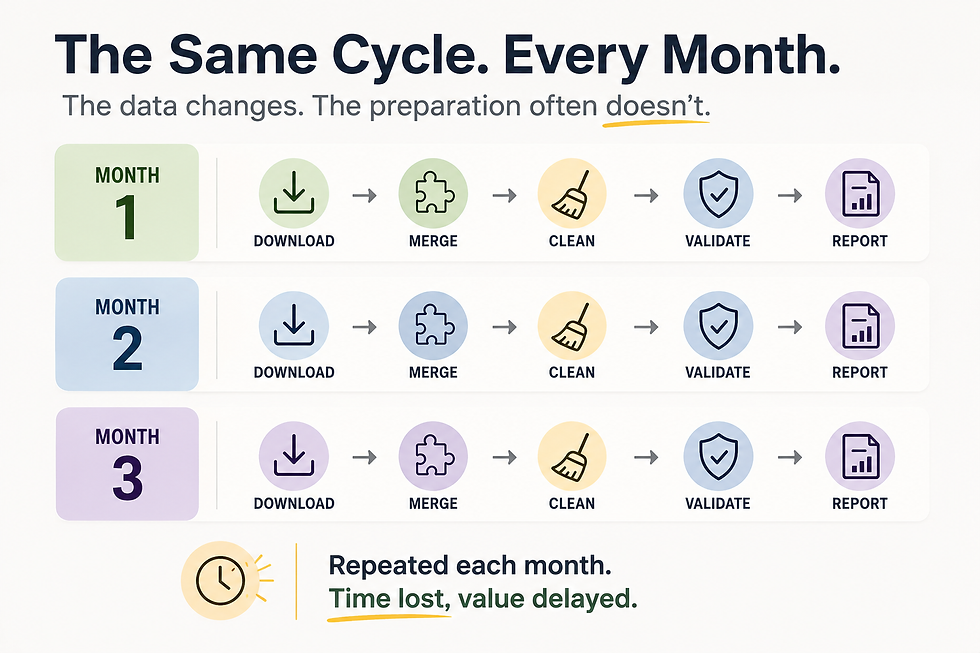
The issue isn't data cleaning. The issue is repetition.
When work becomes repetitive, it deserves a different question.
Not "Can we eliminate it?"
But "Can we do it smarter?"
That simple shift in thinking changes everything.
Instead of rebuilding the same process every month, we begin looking for ways to standardise, streamline and automate repetitive tasks where appropriate. We aren't removing data preparation from analytics. We're making it more efficient so that it supports everything else that follows.
Creating Time for Better Analytics
In my analytics programs, I often describe analytics as a journey.
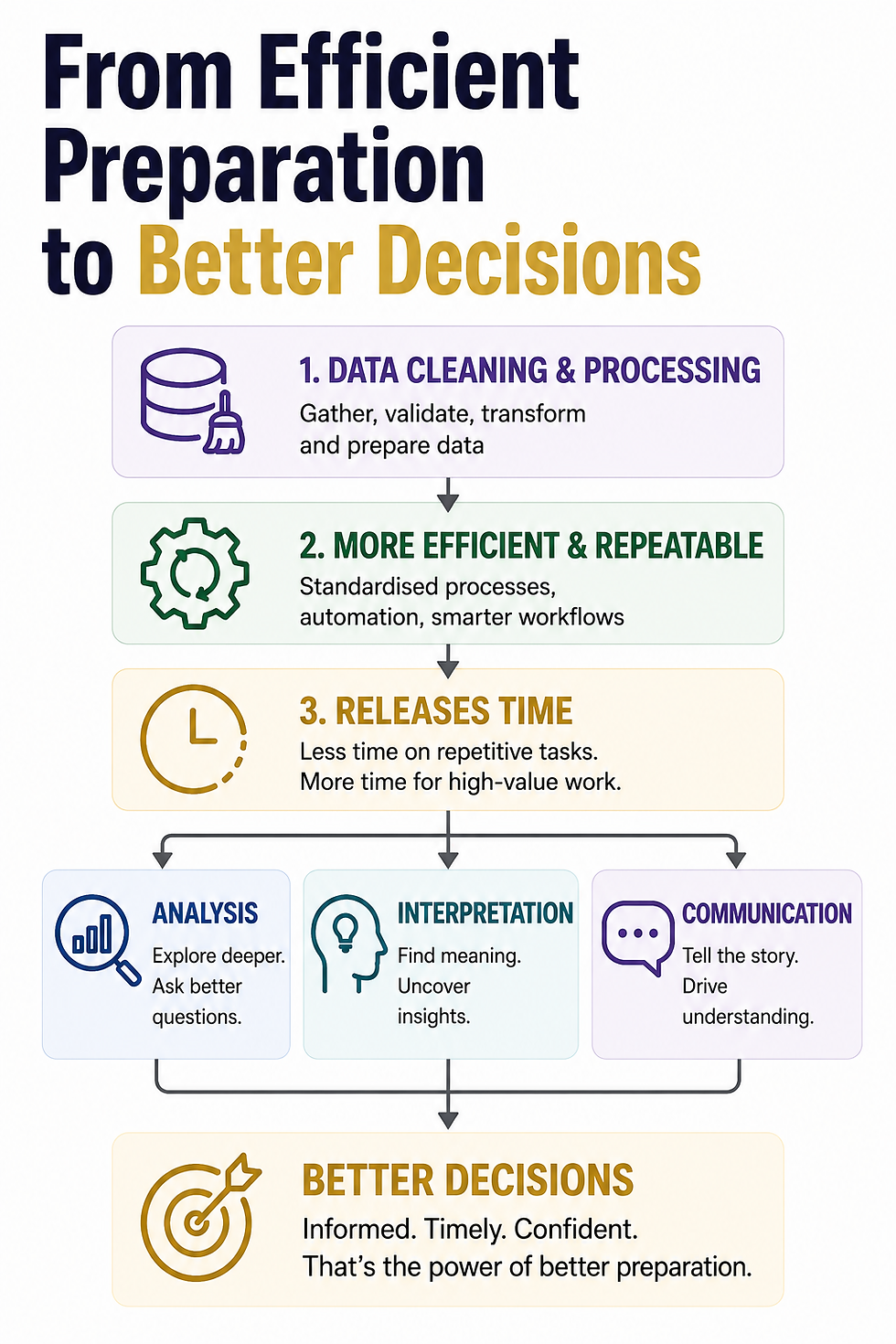
We begin by defining the business problem, then prepare the data, analyse it, interpret the findings and finally communicate insights that support better decisions.
Every stage matters.
The challenge arises when one stage quietly begins consuming the time intended for all the others.
If preparation dominates the reporting cycle, analysis becomes rushed. Interpretation becomes superficial. Communication focuses on presenting charts rather than explaining what they actually mean. Ironically, the very activities organisations invest in most heavily are often the ones receiving the least amount of time.
Efficiency isn't about spending less effort on preparation.
It's about creating more time for analysis, interpretation and communication.
Every hour saved from repetitive preparation is another hour that can be invested in understanding the business problem, asking better questions and uncovering insights that help the organisation make better decisions.
The Real Goal Isn't Cleaner Data
Several years ago, a participant attended one of my data preparation programmes. Like many others, he left the class eager to try a few ideas when he returned to work.
A few months later, he contacted me unexpectedly.
He wasn't calling to tell me that he'd mastered another feature or discovered a clever shortcut.
He simply wanted to say thank you.
By applying what he had learnt, his team had finally cleaned almost ten years of backlog data that had accumulated over time. More importantly, they now had a dashboard the business could finally trust because it was built on data that was accurate, consistent and usable.
That conversation has stayed with me ever since.
Not because they had cleaned ten years' worth of data, impressive though that was, but because it reminded me what data cleaning and processing are really about.
The goal has never been cleaner spreadsheets.
Nor has it been producing reports more quickly.
The real goal is to give organisations confidence in the information they use to make decisions.
When we become more efficient at preparing data, we don't simply save time. We create capacity. Capacity to analyse more deeply, interpret findings more thoughtfully and communicate insights more effectively. That is where analytics delivers its greatest value.
If there is one thing I hope participants take away from my Data Cleaning and Processing workshop, it isn't another formula, feature or shortcut.
It's the confidence to return to the office, look at a process they've repeated for years and ask a simple question.
"Is there a smarter way of doing this?"
Sometimes the answer saves a few hours each month.
Sometimes, as one participant discovered, it unlocks ten years of data that an organisation had never been able to use properly.
Either way, the outcome is the same.
Better preparation creates better analytics.
Better analytics creates better decisions.
And that's the hidden opportunity in data cleaning and processing.
Looking Beyond the Process
As AI becomes increasingly capable of cleaning, transforming and preparing data, it is tempting to think that data preparation will become less important. I believe the opposite is true.
When repetitive work becomes easier, our expectations simply rise. Instead of asking whether a report was produced on time, organisations will increasingly ask whether the right questions were explored, whether the insights were meaningful and whether better decisions were made. As preparation becomes more efficient, the value of human judgement becomes even more apparent.
Perhaps that is the hidden opportunity.
Data cleaning and processing don't simply improve the quality of data.
They improve the quality of time.
Time that can be reinvested in analysis.
Time that can be spent understanding the business instead of wrestling with spreadsheets.
Time to ask better questions before making better decisions.
In the end, perhaps that is what we should be striving for.
Not simply cleaner data.
But more time for better thinking.


Comments