
It Wasn't AI That Emptied the Entry-Level Rung. In Singapore, the Warning Sign Is a Little Different.

For the past two years, "AI took my job" has become the default headline. It is a tidy story: a machine arrives, a role disappears. But a growing body of research suggests the tidy story is, at best, incomplete — and for graduates in Singapore specifically, the more useful question isn't "is AI coming for me" but "am I, without quite meaning to, making myself easier to replace."
What the global research actually shows
Scott Galloway has been making a version of this point on his newsletter and podcast, and the evidence he points to holds up well. Three independent research efforts, using different data sets and methods, converge on the same conclusion:
Entry-level hiring is falling, not because of AI, but because of remote work. A working paper by economists Peter John Lambert and Yannick Schindler, drawing on hundreds of millions of hiring records across the US, UK, Canada, and Australia between 2017 and 2025, found that junior hiring fell by roughly a quarter to nearly 30% while senior hiring rose. When they tested AI exposure and remote work side by side, remote work stayed a strong, consistent predictor — AI's effect "attenuates sharply" and is often statistically indistinguishable from zero once remote work is accounted for (SSRN).
Remote work explains up to 64% of the rise in youth unemployment. The Federal Reserve Bank of New York compared unemployment among college graduates in their twenties against those over 29, separating "remotable" occupations (software engineering, financial analysis) from ones that require physical presence (nursing, for instance). Their explanation: distributed teams make informal, hallway-style mentorship harder, so employers lean on experienced hires who need less hand-holding — a related study found in-office engineers received about 18% more coding feedback than remote peers (New York Fed, Liberty Street Economics).
Laid-off workers were nearly twice as likely to have been fully remote. A February 2026 Gallup survey of over 23,000 US workers found previously fully remote employees made up 25% of the laid-off, against just 13% of the currently employed — a gap not seen among hybrid or on-site workers (Gallup, via People Matters).

Once a role can be done fully remotely, the same job can just as easily be delivered from a lower-cost location, or handed to software — whether it goes offshore or gets automated becomes a straightforward cost-benefit calculation for the employer, and remote-friendly roles are exposed to both options at once.
Why this reads differently from Singapore
Two Singapore-specific facts change how this argument should land locally, and both push toward more caution, not less:
The regulatory timing. Since 1 December 2024, Singapore's Tripartite Guidelines on Flexible Work Arrangement Requests give every employee the formal right to ask for a flexible or remote arrangement, and require employers to consider it properly (TAFEP). This is a good and overdue piece of workplace policy on its own terms — nothing here is an argument against it. But it does mean that, just as the global research above is showing employers the downside of letting junior roles go remote, more Singapore-based junior employees have a fresh, institutionally-backed channel to ask for exactly that. The timing is an unfortunate coincidence worth being aware of, not a reason to blame the policy.
The cost gap. Singapore is one of the most expensive places in the region to hire: median base pay for a software engineer here runs around S$6,750 a month, versus roughly ₱40,000–65,000 a month (very roughly S$950–1,550) for an equivalent role in the Philippines, with similar gaps against Vietnam and Malaysia (figures from WhatIsTheSalary.com's Singapore and Philippines salary data; confidence level: medium, these are indicative benchmarks rather than a controlled comparison). For a Singapore-based fresh graduate, a remote-capable role is not just "exposed to automation" in the abstract — it is sitting next to a large, English-proficient, digitally fluent regional labour pool at a fraction of the cost.

If a task can be done from a laptop, the honest question an employer asks is not "human or AI" but "which human, in which country, or which AI" — and the cost gap makes that a live conversation, not a hypothetical one.
Put together: a fresh graduate here who insists on a fully remote arrangement isn't just opting into the same risk profile as their counterpart in the US or UK. They are opting into it in a market where the price gap that makes outsourcing attractive is unusually wide, and layering that on top of the mentorship and network costs described below. It is a reasonable personal preference, but it is not a free one — and being clear-eyed about that trade-off, rather than assuming remote work is simply a modern amenity with no downside, is the more useful frame for anyone advising a graduate right now.
To be fair to the data, Singapore's own numbers don't show a crisis today: entry-level PMET vacancies actually rose slightly, from 32,500 in December 2025 to 32,800 in March 2026, and roughly nine in ten graduates from the 2025 cohort found work within twelve months — broadly consistent with past years (HR Forward Asia). So the argument here is prospective and behavioural, not a claim that Singapore graduates are already in trouble. It's a caution about a preference that quietly raises future risk, not a description of present-day carnage.
There is a second, less visible cost to insisting on remote-only work early in a career, and it shows up in the same research rather than being speculation of ours: the mentorship effect the New York Fed identified — junior staff learning faster and getting more feedback in person — and the informal networks that come from simply being seen and known inside an organisation. Early career years are disproportionately when both are built. A graduate who opts out of the office isn't only accepting a higher near-term substitution risk; they may also be trading away the on-the-job coaching and relationship capital that make them harder to substitute for later. None of that is unique to Singapore, but in a small, densely networked job market where who-knows-you carries real weight, it may matter more here than in a larger economy.
So does AI create jobs, or destroy them?
Here the honest answer is "it depends on your time horizon and how much weight you put on a forecast versus a measurement," and both halves of the original instinct are partly right.
Near-term (measured): net negative. S&P Global's tracking of firm-level AI adoption finds a net negative effect on employment over the past year — roughly 5 percentage points more firms reporting AI-related job losses than job gains, narrowing to a projected 2-point gap over the coming year. Tellingly, only 24% of firms cite headcount reduction as a goal of their AI investment; 64% are chasing process efficiency and 59% want productivity gains, with job losses arriving as a side effect rather than the target (S&P Global).
Longer-term (forecast): net positive. The often-quoted counterpoint is the World Economic Forum's Future of Jobs Report 2025, which projects 92 million jobs displaced globally by 2030 but 170 million created, for a net gain of 78 million (WEF).

It's worth being explicit about what that second number actually is: a five-year, survey-based projection compiled from employer expectations, not a measurement of anything that has happened. The WEF's own forecasting history is mixed — past editions confidently projected rapid autonomous-vehicle adoption and a "reskilling revolution" (54% of employees retrained by 2022) that arrived far more slowly and unevenly than billed, alongside calls on the gig economy and manufacturing automation that held up well (Octopus Intelligence). None of that means the 78-million figure is wrong. It means it deserves the same status you'd give any well-constructed forecast: a plausible scenario built on today's stated intentions, not a fact about the future.
Two camps, and neither one is a safe bet yet — which is part of the stress
Ask ten people what a young professional should study or reskill into right now, and you'll broadly get two answers, and the honest problem is that both have real evidence behind them and real gaps in them:
Camp 1: go into a trade. Skilled trades and hands-on technical work — electricians, technicians, tradespeople — look comparatively insulated from AI, and are sometimes framed as riding a wage tailwind from AI's own data-centre and infrastructure build-out. That framing is real but incomplete, and in Singapore it runs into three complications worth naming honestly rather than glossing over:
It cuts against the mainstream script. A pivot into trades goes against Singapore's dominant degree-then-white-collar pathway, and for a graduate who has already sunk years and tuition into a degree, walking that back is a far bigger financial and psychological ask than it sounds like on a whiteboard.
Wages are currently held down by ample labour supply, not scarcity. Singapore's trades wages sit next to a large pool of lower-cost labour — foreign work-permit holders, including from Malaysia, doing comparable work for a fraction of the Progressive Wage Model minimums that citizens and PRs are entitled to. Foreign workers in similar roles have been reported earning roughly S$700–1,800 a month, against a PWM floor of S$1,750 (2023–24), rising to S$2,385 by 2028, for citizens and PRs (TheOnlineCitizen). Commentary on the construction sector's labour shortage makes the same point more directly: the ready availability of cheap foreign labour removes the market pressure that would otherwise push wages — or automation — upward (NUS FASS, Singapore Research Nexus).
The bigger barrier may be perception, not economics. There is broad recognition that trade skills are genuinely valuable — but a persistent stigma (parents steering children toward university as the marker of success, social discomfort with trades even at decent pay) appears to keep many Singaporeans away from these roles regardless of the wage math.
Whether wages for local tradespeople actually rise from here is, honestly, as much a policy question as a market one. Singapore's foreign-worker levies and quotas are a lever government can tighten or loosen, and tightening them would likely push local trades wages up. But that is a trade-off, not a free lunch: it would also raise costs for employers and, potentially, consumers, at a moment when the cost of living is already a live public concern. Whether and how far that trade-off gets made is a political choice, not something the market will settle on its own — we won't try to predict it here.
Camp 2: go toward AI. Prompting, data literacy, AI-assisted workflow design, AI engineering — the bet that the safer long-term move is toward the technology itself, not away from it. A fair criticism of an earlier cut of this piece is that it underrated how much time and hands-on repetition it genuinely takes to become expert-level effective with AI, not just conversant with it. The evidence on that is itself splitting in an interesting way:
Plenty of real value doesn't require deep expertise. Roughly 84% of AI coding-tool adoption in 2026 reportedly involves people with no formal engineering background, and there are now credible examples of non-technical builders scaling real products with these tools — one solo, non-developer founder reportedly grew a product to over US$800,000 in annual revenue within nine months with no direct coding involved (Value Add VC).
But there's a real ceiling, and deep skill still lives there. The same reporting found roughly 65% of these "vibe-coded" apps carried security vulnerabilities, and technical debt rose 30–41% after teams adopted these tools — the point past which "an app that demos well" needs someone with genuine expertise to make it secure, scalable, and reliable.
More people chasing the AI-skills path also means more competition, and the wage picture is genuinely mixed. At the very top of the market, pay for frontier AI engineering roles has been volatile — one compensation tracking series showed median pay for AI engineers falling roughly 22% within a year before partially recovering, which some read as an early sign of a cooling, oversupplied market. But at the broader enterprise level, demand for AI-fluent workers reportedly grew roughly sevenfold in two years, and a 2026 ManpowerGroup survey of over 39,000 employers ranked AI skills the hardest in the world to fill for the first time (Pin.com compensation analysis). Both things can be true at once: pay may be frothy for a small number of headline roles even as most employers still can't find enough AI-capable people.
Singapore's own labour data captures this tension well:
Confidence gap. A ManpowerGroup survey found that while 85% of Singapore employees feel confident doing their current job, that confidence drops to 69% when AI enters the picture.
Support gap. More than half of workers (54%) report no recent training and no recent mentorship to help close that gap.
Vacancy gap. Long-unfilled PMET vacancies rose from 14.4% to 16.0% of openings, reversing three years of improvement, with employers citing a lack of specialised skills (52.3%) and insufficient relevant experience (48.2%) — not a lack of applicants.
Rising demand. Close to one in five job postings here now mention AI-related skills specifically, roughly double the share from a year earlier (The QD Academy, citing ManpowerGroup and MOM data).

Read together, this is a labour market that has clearly decided AI skills matter, while offering very little structured help for getting there, and no consensus on whether the safer long-term move is toward AI or away from it into hands-on trades. That is a genuinely uncomfortable position for anyone early in their career or facing a mid-career pivot, and it is entirely reasonable that it is producing real anxiety. The honest, if unsatisfying, thing to say is that this uncertainty is not a communication failure that better advice would fix — it reflects a labour market still working out the answer for itself.
The rehiring rumour — worth holding loosely
One more piece of popular wisdom is worth a sceptic's eye: the idea that companies cutting jobs and citing AI quietly rehire the same people at lower pay.
What's documented: a meaningful share of AI-cited layoffs are being reversed. Forrester's Predictions 2026 report found 55% of employers surveyed already regret AI-driven cuts, and separate tracking shows "boomerang" rehiring rates that have been ticking upward (The Register; Axios).
What's not documented: the "hired back for less" part. Forrester's comment on lower pay is a forward-looking prediction, not a documented pattern, and the reporting on actual rehires is largely silent on wages one way or the other.
The instinct to doubt the universal version of this story is the right one to hold: some of it is almost certainly happening, but treating it as the default outcome overstates what the evidence currently supports. Confidence level: low-to-medium — a real phenomenon with an unsettled wage story, not a settled fact.
No one has found the new normal yet — and that's the real headline
This is where the organisational-design argument lines up closely with the data. McKinsey's State of Organizations 2026 found:
86% of leaders feel unprepared to run AI in day-to-day operations
88% of organisations are experimenting with AI
81% report no meaningful bottom-line gains yet
23% qualify as what the report calls "AI Pioneers" — organisations with a genuinely clear vision for
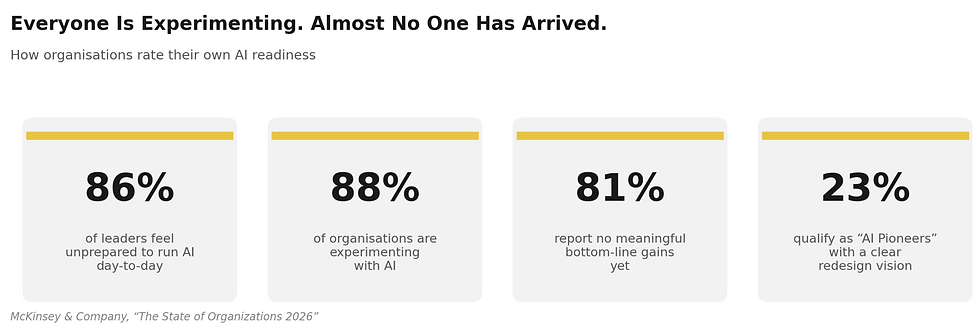
how AI reshapes their work and the skills it requires (McKinsey)
In other words: almost everyone is experimenting, almost no one has arrived — globally, and Singapore's own AI-adoption figures show the same unevenness by company size (roughly 27% adoption among smaller firms versus 76% among large ones), so this isn't a gap that's about to close uniformly either.
What to actually do about it, in the meantime
None of the analysis above is much use without a next step. In the spirit of FYT's own view that AI accelerates tasks while humans still have to interpret and decide, here is what we'd actually tell someone standing in the middle of this uncertainty right now.
If you're a fresh graduate:
Take the job, even an imperfect one. A role without WFH, or at pay that's fair but not spectacular (not rock-bottom — fair), still gets you inside a workplace. A start beats waiting for the perfect start. Early jobs are how you build the two things that actually compound over a career: a track record you can point to, and a network of people who've genuinely seen you work. Both are hard to build from outside an organisation, however the job title reads on your CV.
Don't hold out for a role that matches your degree. Employers are ultimately looking for people who can solve problems, work well with others, and create more value than they cost — not a perfect subject-match on paper. Employment is a trade, not a test: done right it's a win-win, not a zero-sum contest where only one side comes out ahead.
For everyone navigating this — fresh graduate or mid-career:
If you can't tell which tasks are AI-proof, bet on the parts of work that stay human. Storytelling that supports a decision, selling, understanding what a client actually needs, teaching and guiding others — these hold up because they depend on judgement and relationship, not just information. The data backs this up: employer priority on "leadership and social influence" rose 22 percentage points since 2023, and empathy, active listening, and leadership are explicitly flagged as not currently at risk from generative AI (WEF, Future of Jobs Report 2025).
Be deliberate about where you spend your time. The market pushes SkillsFuture courses, LinkedIn posting, content creation, and a dozen other visible activities that everyone is told will improve their employability. The problem is in that word "everyone": if you're doing the same course, that anyone can sign up for, in the same way as thousands of other people, you haven't built an advantage — you've built a credential everyone else can point to as well. Competitive advantage doesn't come from doing the popular thing; it comes from doing the thing that fits your own situation, which is precisely why critical thinking and actual experimentation matter more than following a formula. Try something specific to your own strengths and circumstances, see what actually sticks, adjust — rather than copying someone else's playbook and then wondering, a year later, why it didn't produce their results. That includes being selective about whose advice you take in the first place: credibility should come from a track record, not a follower count, and anyone promising a low-risk, no-effort formula for wealth or a career is a signal to walk away, not follow.
The bottom line
None of this is an argument that AI and automation are irrelevant to what's happening in the labour market — they clearly are, and clearly will matter more over time. But the sharpest, most immediate driver of the disappearing entry-level rung looks to be a workplace design choice — remote work — rather than the technology itself, and in Singapore that choice now carries a distinct local edge: a formally-protected right to request it, sitting next to one of the region's largest cost gaps to a remote-capable alternative.
What is genuinely unresolved is everything downstream of that: which tasks get handed to AI, which stay human, whether the safer bet is a trade or a prompt, and how young talent builds the judgment and networks that used to come from sitting near experienced colleagues. Every organisation, and every graduate, is going to answer these questions somewhat differently, and it is entirely possible we end up with several coexisting models rather than one global norm. As with most economic pivot points, there will be real pain in that adjustment, concentrated unfairly on people just starting out, and no small amount of avoidable stress from a lack of clear direction. But there is also real opportunity for the organisations, and the individuals, willing to figure out — deliberately, with eyes open to the trade-offs, rather than by default — where they create more value than they cost, and to build their choices around that answer rather than around convenience or habit.
None of this is settled, and that's rather the point: we'd genuinely like to hear where you land. Are you seeing the WFH-not-AI pattern play out in your own hiring or job search? Which camp — trades or AI skills — are you actually betting on, for yourself or your team? Drop your take in the comments below; the more perspectives in the mix, the better this picture gets.
Sources:
Lambert, P.J. & Schindler, Y., "Remote Work, Not AI, Explains the Decline in Entry-Level Hiring", SSRN working paper
Federal Reserve Bank of New York, "Remote Work Leaves Younger Workers Sidelined", Liberty Street Economics, June 2026
Gallup, tech/remote worker layoff-risk survey, reported via People Matters
TAFEP, "Tripartite Guidelines on Flexible Work Arrangement Requests", effective 1 December 2024
WhatIsTheSalary.com, Singapore and Philippines software engineer salary benchmarks
HR Forward Asia, "Singapore expands graduate employment support as AI reshapes entry-level jobs"
S&P Global, "AI Impact on Employment 2026"
World Economic Forum, "Future of Jobs Report 2025"
World Economic Forum, "Future of Jobs Report 2025 — Skills Outlook"
Octopus Intelligence, "WEF Predicts 78 Million New AI Jobs by 2030: A Reality Check on Their Track Record"
The QD Academy, "The AI Skills Gap in Singapore: What MOM Data Really Tells Us", citing ManpowerGroup and Ministry of Manpower data
TheOnlineCitizen, "Tan Kin Lian's grass-cutting question sparks fierce online debate over wages and dignity", June 2026
NUS FASS, Singapore Research Nexus, "Foreign labour shortages in construction sector is a wake-up call for change"
Value Add VC, "Vibe Coding for Non-Technical Founders: 84% Adoption and What They're Actually Shipping"
Pin.com, "AI Compensation Benchmarks 2026: The AI Hiring Bubble"
The Register, "AI layoffs to backfire: half quietly rehired at lower pay", citing Forrester's Predictions 2026
Axios, "'Boomerang' hires suggest AI layoffs aren't sticking", November 2025
McKinsey & Company, "The State of Organizations 2026"


Comments