
Raising Singapore's Retirement Age: Working Longer, or Having the Choice to?

Singapore's move to raise the retirement age to 65 and re-employment age to 70 has sparked concerns. But are we confusing the right to work longer with the need to do so?
Singapore's announcement on 26 October 2026 to raise the retirement age to 65 and re-employment age to 70 from January 2029 has stirred considerable debate.
Some worry that Singaporeans are being made to work until they die. Others see it as an admission that rising living costs have made retirement increasingly unaffordable.
These concerns are understandable. But they also reflect some misconceptions about what the policy actually does.
The policy is not about making Singaporeans work longer. It is about giving those who want or need to work longer greater protection and opportunities to do so.
However, whether these opportunities translate into meaningful employment is another question altogether.
1. Retirement age is not the age you must retire
Singapore has been progressively raising its retirement age for decades, from 60 in 1993 to 62 in 1999, 63 in 2022 and 64 in July 2026.
The latest announcement brings the next increase to 65 forward to January 2029.
But what does this actually mean?
Under the Retirement and Re-employment Act, employers cannot retire employees simply because of their age before the statutory retirement age.
It does not mean employees must continue working until then.
Singaporeans can still choose to retire at 45, 55 or 60, provided they have the financial means to do so. The CPF payout eligibility age also remains at 65, regardless of the changes.
Importantly, protection against age-based retirement is not a guarantee of employment.
Employers can still dismiss employees for legitimate reasons, including poor performance, misconduct or genuine business restructuring, subject to the law.
Employees, regardless of age, must still perform satisfactorily and contribute to their organisations.
The law protects older workers from being retired simply because they are old. It does not guarantee them a job regardless of circumstances.
2. Re-employment creates opportunities, not guaranteed jobs until 70
Re-employment provides another layer of protection.
Employers must offer eligible employees the opportunity to continue working beyond the statutory retirement age, up to the re-employment age.
But there are conditions.
Employees must meet requirements such as satisfactory performance and medical fitness. Re-employment may also involve a different role, reduced responsibilities, flexible working hours or a reasonably adjusted salary.
Consider a 65-year-old manager who no longer wishes to lead a large team or handle demanding schedules.
Re-employment could allow that person to move into a less stressful advisory or supporting role, perhaps with shorter hours and lower pay.
For someone who wants to remain active or still needs an income, this may be preferable to having no job at all.
Where employers genuinely cannot offer suitable re-employment to eligible employees, they must meet their legal obligations, including making an Employment Assistance Payment where applicable.
Employees can also choose not to accept re-employment, although their entitlements will depend on the circumstances.
The intention is to provide a pathway for continued employment, not to guarantee the same position, seniority or salary until 70.
3. The real challenge is whether older Singaporeans can afford to retire
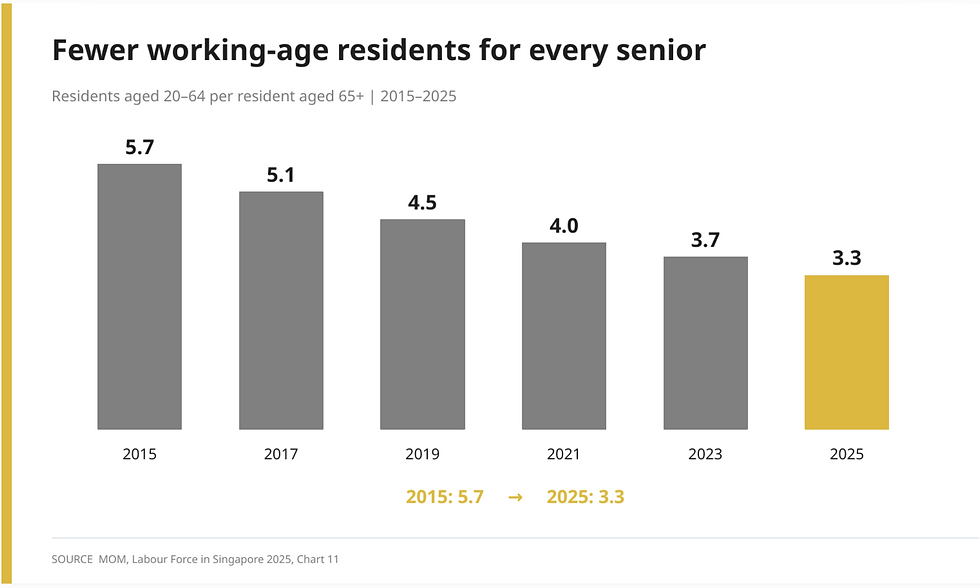
Singapore is ageing rapidly.
In 2026, citizens aged 65 and above accounted for 21.4% of the citizen population, compared with 13.7% just ten years earlier.

Meanwhile, approximately two-thirds of residents aged 65 and above were outside the labour force in 2025. Some have saved enough to enjoy retirement. Others may rely on CPF payouts, family support or other income. But some are also outside the workforce because of poor health, caregiving responsibilities or difficulty finding suitable jobs.

We should not assume that everyone who has retired is financially comfortable, just as we should not assume that everyone still working at 70 is doing so out of desperation.
There are also challenges unique to today's older generation.
Many grew up when university education was far less accessible. While they may have accumulated decades of valuable experience, they may not possess the formal qualifications increasingly required by employers.
Others face physical limitations that make continuing in demanding jobs difficult.
And with technology changing how work is done, some may struggle to keep their skills relevant.
These are genuine challenges that raising the retirement age alone cannot solve.
Allowing someone to work until 70 is one thing. Ensuring they can find suitable work and earn a meaningful income is another.
4. Older workers: A burden or an overlooked competitive advantage?
This is where I believe the conversation needs to change.
Much of the debate treats older workers as a group that businesses must accommodate, whether through regulation, financial incentives or social responsibility.
But are we overlooking their economic value?
Singapore's ageing population also represents a growing pool of workers with decades of industry knowledge, practical experience, professional relationships and judgement.
They may not always possess the qualifications employers seek today. But that does not mean they lack valuable capabilities.
Consider an experienced technician who can diagnose equipment problems that younger colleagues have never encountered. Or a seasoned customer service professional who knows how to defuse difficult situations. Or an operations manager who understands why certain processes exist because they have personally experienced the consequences when things go wrong.
These capabilities take years to develop and cannot always be measured by academic qualifications.
In sectors such as engineering, manufacturing, logistics, hospitality and professional services, they could provide businesses with a genuine competitive advantage.
And in the age of AI, where access to information and technical knowledge is becoming easier, human experience, sound judgement and the ability to apply knowledge in context may become even more valuable.
The opportunity is not necessarily to keep older employees doing exactly the same jobs.
It may be to redesign roles that better use their strengths, whether in mentoring, quality assurance, troubleshooting, customer relationships or specialist advisory work.
For some businesses, a combination of younger workers' technological familiarity and older workers' practical experience could be more valuable than either alone.
Of course, age does not automatically make someone a valuable employee. Experience can become outdated, and older workers must also be willing to learn and adapt.
Nor should employers be expected to retain workers without a sound business case.
But perhaps businesses that learn to recognise and deploy experienced talent effectively may discover a competitive advantage that others have overlooked.
Rather than seeing older workers simply as a social obligation, could we start seeing them as an underused economic resource?
5. Legislation alone cannot create sustainable employment
Ultimately, employers must remain competitive.
They face rising costs, changing customer demands and increasing pressure from technology and AI.
Legislation can protect older workers from unfair retirement, but it cannot guarantee that businesses will have suitable jobs for everyone.
If employment obligations become too costly or restrictive, some businesses may respond by reducing hiring, automating work or relocating activities.
These are possible risks, not inevitable consequences, but they deserve consideration.
On the other hand, businesses that adapt their work arrangements and make better use of experienced employees may benefit from a valuable source of talent.
The Government's proposed support for more flexible work arrangements is a step in this direction.
The challenge is finding arrangements that benefit both employees and employers, rather than relying indefinitely on regulation or subsidies.
And this raises a bigger question: How should we measure whether the policy succeeds?
Simply increasing the number of employed seniors is not enough.
We should also ask:
Are older Singaporeans who want to work finding suitable, meaningful employment?
Are their incomes and financial security improving?
Are businesses benefiting from their experience and contributions?
Are flexible work arrangements making it easier for older workers to remain productive?
Are the policies encouraging businesses to hire and retain older workers, or creating unintended costs that discourage employment?
These outcomes will tell us far more than the statutory retirement age itself.
6. The goal should be more choice, not simply longer careers
I understand why the announcement has generated strong emotions.
For those struggling with rising costs, inadequate savings or declining health, the prospect of working until 70 may be deeply unsettling.
These concerns are real and deserve attention.
But we should distinguish between the intention of the policy and the wider economic challenges of retirement.
Raising the retirement and re-employment ages gives eligible older Singaporeans greater protection and opportunities to continue working.
It does not force them to work until 70, nor does it guarantee employment regardless of performance or business circumstances.
More importantly, the success of this policy will depend on what happens beyond legislation.
Older workers must remain willing and able to contribute. Businesses must find ways to make productive use of their capabilities. And policymakers must ensure that employment protections do not unintentionally discourage the very opportunities they seek to create.
Singapore is entering an era where more people will live longer, healthier lives. That presents challenges, but also opportunities to rethink how we work, contribute and retire.
Perhaps the goal should not be to make everyone work until 70, but to ensure that those who wish to retire can afford to, while those who want or need to continue working have a fair opportunity to contribute.
And for businesses willing to look beyond age and paper qualifications, that opportunity could be a competitive advantage waiting to be discovered.
Sources
Ministry of Manpower, Tripartite Workgroup Recommendations, 26 October 2026: https://www.mom.gov.sg/newsroom/press-releases/2026/1026-twg-se-recommendations
Ministry of Manpower, Responsible Re-employment: https://www.mom.gov.sg/employment-practices/re-employment
National Population and Talent Division, Longevity: https://www.population.gov.sg/our-population/population-trends/longevity/
Ministry of Manpower, Labour Force in Singapore 2025: https://stats.mom.gov.sg/


Comments