
The Advantage Is Not More Data or More AI - It Is Knowing How to Combine Human Judgement, Analytics and AI to Solve Problems Better

For more than a decade, FYT has worked with organisations to build practical Data Analytics capabilities.
During that time, we have seen technologies rise, mature and sometimes fade into the background.
Excel. R. Python. Tableau. Power BI. Machine Learning.
More recently, attention has shifted towards Generative AI, copilots, connectors and agents.
The technologies keep changing.
But the things organisations need to accomplish have changed far less.
Businesses still need to understand customers.
Leaders still need to allocate resources.
Teams still need to improve processes.
Organisations still need to decide what to prioritise, what to stop and what to do next.
What has changed is how these things can now be done.
Data gives us better ways to understand problems and make informed decisions.
AI gives us new ways to perform work, process information and increasingly automate tasks at scale.
But neither removes the need for human judgement.
This leads to a simple view that increasingly shapes how we think about capability building at FYT:
The advantage is not having more Data or more AI. It is knowing how to combine human judgement, Analytics and AI to solve problems better.
Start with the problem, not the technology
One of the easiest mistakes to make today is to begin with the tool.
“We should use AI.”
“We need a dashboard.”
“We should automate this.”
“We need an agent.”
None of these statements actually defines the problem.
At FYT, we believe the starting point should instead be:
What are we trying to achieve?
Then:
Why does it matter?
What might be causing the issue?
What would a good outcome look like?
What do we already know?
What do we still need to find out?
Only then should we ask:
What is the most appropriate way to solve it?
That answer may involve Analytics.
It may involve AI.
It may depend heavily on experienced human judgement.
Increasingly, it may involve all three.
Human judgement remains part of the system
It is tempting to describe human judgement as something that Data and AI eventually replace.
We do not see it that way.
Experienced people accumulate enormous amounts of qualitative information over their careers.
They recognise patterns.
They remember what happened the last time something similar occurred.
They understand organisational personalities, operational constraints and circumstances that may never appear neatly in a database.
That experience can be enormously valuable.
But experience is not infallible.
Two people can go through similar situations and draw very different lessons from them.
Past experience can also be influenced by confirmation bias, availability bias, selective memory or simply limited exposure.
So the answer is not to discard judgement.
It is to strengthen it.
That is where critical thinking and data become important.
Experience gives us ideas about where to look.Critical thinking helps us challenge what we believe. Data helps us test it.
And the process works in reverse as well.
Someone early in their career may not yet have years of accumulated experience.
But they can use data, structured methods, critical thinking and feedback to learn more systematically.
Over time, those observations become experience.
So good judgement is not simply something we either possess or lack.
It can be built.
Analytics: using evidence to strengthen human judgement
This is the role Analytics has played for many years.
Contrary to popular belief, Analytics does not really start with Data.
It starts with a question.
Suppose management believes employee turnover is being driven by poor career progression.
An experienced HR leader may have good reasons for believing that.
But instead of treating the experience as the conclusion, Analytics allows us to turn it into a hypothesis.
Can career progression be measured?
Does resignation differ between employees who were promoted and those who were not?
Are there competing explanations, such as pay, tenure, workload or management?
That creates a much stronger process:
Experience → Hypothesis → Data → Evidence → Interpretation → Judgement
The role of data is not to replace management judgement.
It is to make that judgement better informed and more testable.

Data does not make the decision
Even when analysis is rigorous, the result rarely says:
“This is definitely what management should do.”
The data may show that employees under certain managers have much higher resignation rates.
But someone still needs to ask:
Why?
Is the relationship causal?
What else could explain it?
What options are realistic?
What might the unintended consequences be?
This is where judgement returns to the process.
Analytics augments human intelligence by giving people a stronger basis for making decisions.
It does not remove the need to interpret the evidence in context.
That is why FYT's definition of Analytics focuses on the systematic use of data and quantitative methods to support informed decisions.
The value does not come from the data itself.
The value comes when the data contributes to a better decision — and that decision is acted upon.

Informed decisions still matter when they fail
There is another benefit of making decisions this way.
An informed decision does not guarantee the right outcome.
Businesses operate in uncertain environments.
Competitors react.
Customers behave unexpectedly.
Economic conditions change.
But a decision built on explicit hypotheses and evidence creates a much stronger basis for learning.
If the intervention works, we can ask:
Which signals did we identify correctly?
If it fails:
Which hypothesis was wrong?What did we overlook?What should we test next?
So the cycle becomes:
Hypothesis → Evidence → Decision → Outcome → Learning → Better Judgement
That is very different from simply saying:
“We thought it would work.”
Where AI changes the equation
Analytics primarily helps people understand and decide.
AI opens another possibility.
It can increasingly help organisations perform the work itself.
That means the question changes from:
“What does the evidence tell us?”
to:
“Can AI help us do this task, or perhaps eventually do much of it for us?”
At FYT, we see that capability developing in stages.
Level 1 — Assist
At the first level, AI helps an individual perform a particular task.
Draft this email.
Summarise this report.
Analyse these comments.
Generate options.
Explain this concept.
The human remains firmly involved.
And human judgement matters immediately:
Is this answer sensible?Is it accurate enough?Is it fit for purpose?
The goal is not always perfection.
The goal is to determine whether the output is good enough for the task and the consequences involved.
Level 2 — Contextualise
General AI systems know a great deal, but they do not automatically understand how a particular organisation works.
So organisations may provide:
policies;
examples of good work;
preferred terminology;
templates;
organisational context;
standards and boundaries.
Now another form of judgement becomes important:
What should we teach the AI?
If the examples are poor, inconsistent or biased, those weaknesses can find their way into the outputs.
Someone needs to choose appropriate information, evaluate the results and determine whether the AI has learnt the intended behaviour.
Level 3 — Connect and Do
AI becomes much more powerful when it can interact with the systems where work actually happens.
Email.
Spreadsheets.
Databases.
Websites.
Enterprise applications.
Now AI moves from:
producing an answer
to:
taking an action.
And the role of judgement changes again.
Organisations must decide:
what systems AI can access;
what information it can use;
which actions it may take;
what requires human approval;
what happens when something goes wrong.
Level 4 — Delegate
Agentic AI pushes this further.
Instead of prescribing every step, we increasingly give AI an objective and allow it to determine some of the steps required to achieve it.
Traditional automation largely says:
Follow these instructions.
Agentic AI increasingly says:
Achieve this outcome.
That flexibility may be valuable.
But it also introduces much greater uncertainty.
At this point, good judgement involves asking:
What could go wrong?How would we know?What level of reliability is acceptable?When should a human intervene?What should happen when the environment changes?
The goal should therefore not be to reach the highest level of AI capability.
It should be:
Use only as much AI autonomy as the problem justifies.

Analytics and AI are not opposing tracks
The interesting part is that Analytics and AI increasingly work together.
Imagine an organisation receiving thousands of written customer comments.
AI may help:
read and classify the comments into themes.
Those themes become structured data.
Analytics can then examine:
which issues are increasing;
where they occur;
which customers are affected;
whether an intervention made a measurable difference.
Management interprets the results and decides what to change.
AI may then assist staff or automate parts of the resulting workflow.
So the process might actually become:
AI → Data → Analytics → Human Judgement → AI-enabled Action
That is why we do not see the future as a competition between Analytics and AI.
The opportunity lies in knowing how to combine them.
Different problems need different combinations
Not every problem deserves the same treatment.
A routine and low-consequence decision may rely heavily on experience.
A major investment decision may justify significant data collection and analysis.
A repetitive, information-heavy process may be ideal for AI assistance or automation.
A complex strategic problem may require:
experienced judgement + analytics + AI
The important capability is therefore not simply knowing how to use a tool.
It is knowing:
what kind of problem we are dealing with and what combination of capabilities it deserves.
That is a much more durable organisational skill.
Critical thinking connects the entire system
This is why we increasingly see Critical Thinking in the Age of Data and AI as a foundational capability.
Critical thinking helps someone challenge their own experience:
Am I assuming too much from what happened previously?
It helps an analyst challenge the data:
Does this result really support the conclusion?
And it helps an AI user challenge the machine:
Is this output reasonable, complete and fit for purpose?
As technologies become easier to use, this capability becomes more important rather than less.
Because it is increasingly easy to produce an answer.
The harder question is:
Should we believe it?
And organisations need foundations underneath both tracks
Individual capability alone is not enough.
Organisations also need an environment that supports good use of both Data and AI.
Two areas are particularly important.
Building a Data and AI culture
People need to be willing to:
ask questions;
use evidence;
challenge assumptions;
experiment;
learn from outcomes.
Buying technology does not create that culture.
Building a Data Strategy
Analytics and AI both depend on information.
Organisations need to understand:
what data matters;
how it is defined;
where it resides;
whether it can be trusted;
who owns it;
who should have access.
The rise of AI therefore does not make good Data Strategy less important.
Arguably, it makes it more important.
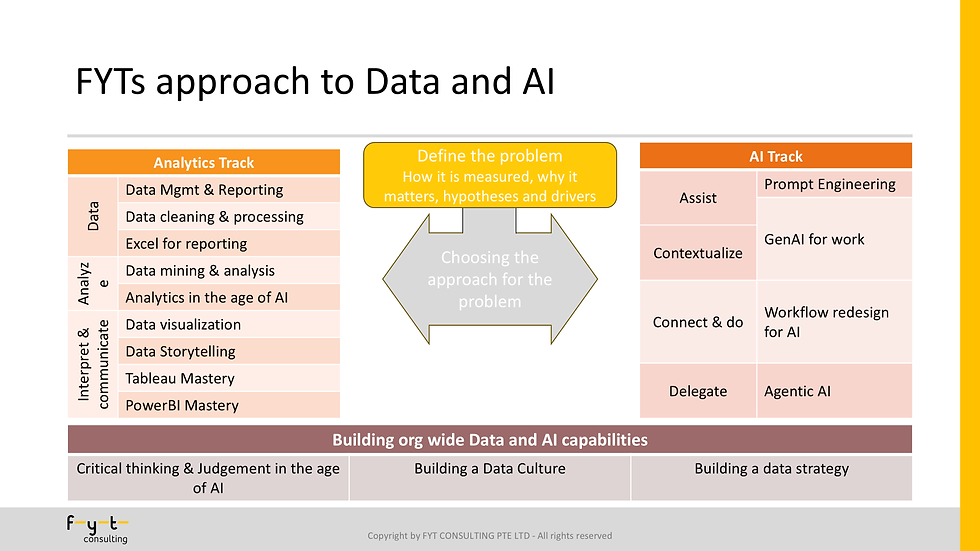
Building capability as a system
This thinking shapes how FYT is developing our own curriculum.
Our Analytics programmes have been built and refined over more than a decade.
They help learners move from:
Data Management → Analysis → Visualisation → Storytelling → Decisions
Our growing AI curriculum develops capability progressively from:
Assist → Contextualise → Connect & Do → Delegate
And underneath both sit the organisational and human foundations:
Critical ThinkingData CultureData Strategy
The purpose is not to convince every organisation to adopt every capability.
Nor do we believe every problem should eventually become an AI problem.
The objective is to build enough breadth across the system that organisations can choose intelligently.
The tools will keep changing
There will be another analytics tool.
Another AI model.
Another agent framework.
Another technology that attracts attention.
Some will be genuinely transformative.
Some will quietly disappear.
Organisations cannot sustainably build capability by chasing each new platform.
What they can build is something much more durable:
people who understand problems;
people who know how to use evidence;
people who can challenge their own assumptions;
people who understand what AI can and cannot do;
and organisations capable of combining these strengths appropriately.
That is where we believe the real advantage lies.
The advantage is not having more Data or more AI. It is knowing how to combine human judgement, Analytics and AI to solve problems better.
Building capability for the Data and AI economy
FYT helps organisations build these capabilities at both the individual and organisational level.
From Critical Thinking and practical Data Analytics, to Generative AI, AI-enabled workflows, Data Culture and Data Strategy, our workshops are designed around one common philosophy:
Start with the problem.Understand what it requires.Use the appropriate combination of human judgement, Analytics and AI.Learn from the outcome.Keep improving.
Because thriving in the Data and AI economy will not simply be about knowing how to use more technology.
It will be about knowing when, where and why to use it. If your organisation is looking to build a practical and executable advantage in the age of Data and AI, we would be happy to explore what that could look like with you.
Whether you are strengthening your analytics capability, introducing AI into everyday work, redesigning workflows, or simply trying to make sense of where to begin, FYT’s workshops are designed to help organisations build the right capabilities for the right problems.
Contact us to find out more about our Data, Analytics and AI workshops, or to discuss how we can help your organisation build capability that creates practical value—not just more technology.


Comments