
Your Data Problem Isn’t Data. It’s This.
Part 1 of a Series: From Messy Problems to Clear Definitions

The Problem Isn’t What You Think
Most teams think they have a data problem.That’s why they keep solving the wrong thing.
In many organisations, the pattern is familiar. Dashboards are built, reports are generated, and metrics are tracked with increasing sophistication. Yet when it comes to making decisions, very little seems to move. Meetings end with more questions than answers, and at some point, someone inevitably says, “We need more data.”
But the issue isn’t the lack of data.
It’s the lack of clarity.
And without clarity, even the best data struggles to be useful.
Where Things Start to Break Down
Most business problems don’t begin in a clear or structured way. They start messy, not in a dramatic sense, but in a very ordinary, everyday way.
A request comes in. It sounds reasonable. It sounds urgent.
“Sales are dropping. Can we analyse what’s happening?”
It feels like a problem statement. But if you pause for a moment, it quickly becomes clear that it isn’t. It’s a collection of assumptions compressed into a single sentence.
Which sales are we talking about? Which market? Over what time period? Compared to what baseline?What decision are we trying to support?
Until those questions are addressed, there is no real problem definition. There is only a situation that feels important.
A Familiar Scene
You’ve probably been in that meeting.
Everyone nods when the problem is raised. Someone suggests pulling data. Another mentions building a quick dashboard. The conversation moves quickly, and before long, work has already begun.
It feels productive. It feels like progress.
But if you step back, something is missing. No one has actually agreed on what the problem is.
And yet, analysis is already underway.

Everything is possible. Nothing is precise.
This is where most analytics work actually begins.
Why We Jump Into Analysis Too Quickly
In practice, teams rarely pause to define the problem properly. Instead, they move quickly into execution.
Data is pulled, dashboards are built, and reports start taking shape.
There’s a reason for this. Analysis feels tangible. It creates visible output. It signals movement.
Problem definition, on the other hand, feels slower. It requires alignment, discussion, and sometimes uncomfortable clarification. It forces people to commit to what actually matters.
So it is often skipped, not deliberately, but quietly.
The hope is that clarity will emerge along the way.
But it rarely does.
Because when the question is unclear, the answer will always be too.
Why More Data Doesn’t Fix It
At this point, the natural response is to reach for more data.
If we look deeper, expand the dataset, or build a better dashboard, surely the answer will reveal itself.
But more data does not create clarity. It simply gives you more ways to explore the same ambiguity.
What follows is a familiar pattern. More charts are produced, but direction remains unclear. More metrics are tracked, but their meaning is still debated. Analysis becomes more detailed, but decisions remain just out of reach.
The problem is no longer technical.
It is conceptual.
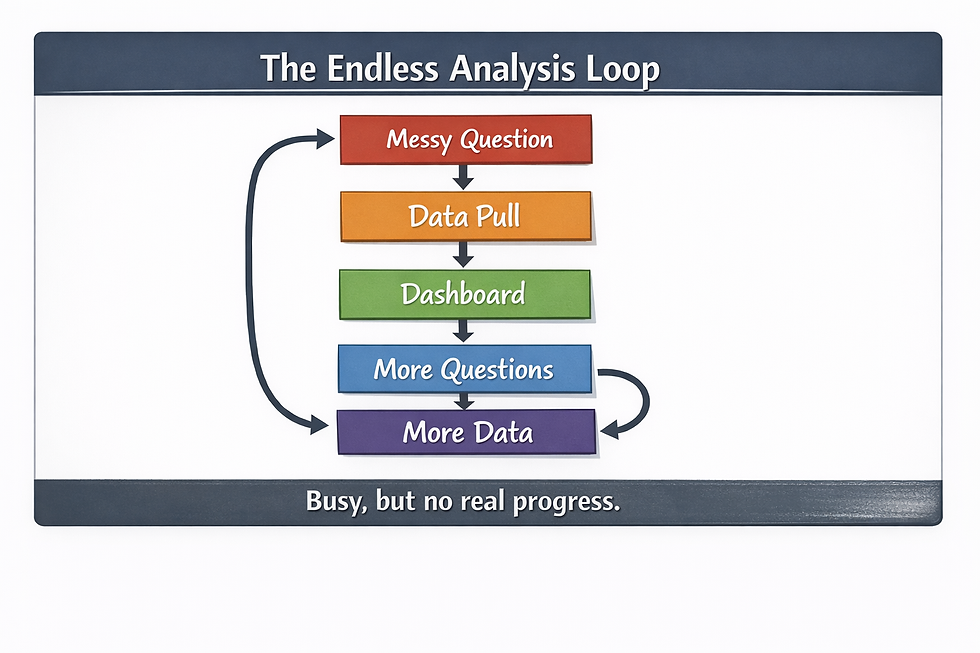
A process that looks busy, but rarely leads to decisions.
Where Good Analytics Actually Begins
Good analytics does not begin with data. It begins with clarity.
A more effective approach is not to rush into analysis, but to pause and introduce structure. To take that messy situation and work it into something that can actually be analysed.

Clarity comes before analysis.
The Role of Frameworks
This is where frameworks come in, and also where they are often misunderstood.
Frameworks are not there to provide answers. They are there to help you think clearly enough to ask better questions. In fact, good frameworks don’t give you clarity. They expose whether you actually have it.
They force a level of thinking that is otherwise easy to avoid.
What exactly are we trying to solve?
Who is this problem for?
What does success look like?
What should we measure, and why?
When these questions are addressed, something shifts.
The earlier example of “sales are dropping” begins to take shape. It becomes something more precise, more grounded.
Sales from new customers for Product A have declined over the past three months. The objective is to understand why, and to identify actions that can improve conversion.
Now the problem is specific. Measurable. Actionable.
And most importantly, worth analysing.

Same situation. Very different starting point.
Why This Matters More Than You Think
In many teams I work with, this is where data projects quietly fail.
Not because of poor tools. Not because of lack of skills.
But because the problem was never properly defined in the first place.
And when that happens, the cost is not just bad analysis.
It’s wasted time, misaligned teams, and decisions made on the wrong problem.
You end up building dashboards that no one uses. Tracking metrics that don’t drive action. Running analysis that doesn’t change decisions.
Over time, people start to lose trust in the data. When in reality, the issue was never the data to begin with.
Where This Series Goes Next
This article is the starting point of a larger conversation.
Not about tools. Not about techniques.
But about how we think before analysis begins.
In this series, we’ll break down a set of practical frameworks that help turn messy situations into clear problem definitions. Each one addresses a different kind of ambiguity, from understanding what your numbers actually represent, to aligning data work with real business outcomes.
We start with one of the most common challenges:
Having numbers, but not knowing what they actually mean.
In the next article, we’ll look at the KPI Dimension Map, and how it helps turn high-level metrics into something you can actually act on.
Closing Thought
Clarity is not the result of analysis. It is the starting point.


Comments