
The Job Market Isn't Broken — Your Map might be
There's a pattern in the headlines lately that's hard to ignore.
Fresh graduates sending out hundreds of job applications and hearing nothing back.
Singapore businesses quietly — and not so quietly — moving their operations to Malaysia and beyond.
A recruiter going viral for saying Singaporeans aren't "hungry" enough. Each story feels separate. Each sparks its own outrage cycle.
But what if they're all telling the same story?
We'd like to offer a different lens for reading this moment — one borrowed not from economics or HR theory, but from the world of decision-making and complexity science. It's called the Cynefin framework (pronounced kuh-NEV-in, from the Welsh word for "habitat"). And once you see the job market through it, you can't unsee it.

The Map That Most Singaporeans Grew Up With
For the better part of three decades, Singapore operated on a beautifully simple career playbook:

It worked. For a long time, it worked remarkably well. And why wouldn't it? The rules were clear, the path was proven, and the rewards were real.
In Cynefin terms, this is what's called a Simple (or "Obvious") problem: the relationship between cause and effect is clear to everyone. The solution is known. You follow the recipe. You get the result.
But Simple problems carry a quiet trap built into them. They work brilliantly — right up until the underlying assumptions shift. And when they do, they don't gradually degrade. They fall off a cliff.That cliff has a name. And we're standing at its edge.
When the Recipe Stops Working or doesn't work as well
Here's what the numbers actually show: Singapore's unemployment rate remains low. The jobs haven't disappeared.

So why are graduates drowning in unanswered applications?
Because the problem was never about job availability. It's about a mismatch between what candidates expect and what employers are actually willing to pay for — at the price they're being asked to pay.
Think about employment from first principles for a moment. An organisation hires someone because that person helps it create revenue, reduce costs, manage risk, or deliver value in some other meaningful way. The employee offers their time and skills; the employer pays a predetermined price for those. It's a contract. A straightforward exchange.
The degree used to serve a practical purpose in this exchange: it was a reliable signal to employers that a candidate could do the job. But that signal is weakening. Many employers will tell you — privately, if not publicly — that a degree alone tells them far less than it once did about whether someone can actually deliver. At the same time, the price of that signal has never been higher. Graduate salary expectations have climbed. Business costs — rent, CPF contributions, regulatory compliance — have climbed faster.
And the data backs this up in a way that should give everyone pause.
What the Numbers Actually Say
Singapore's value added (VA) per employee dollar across ten industry sectors from 2004 to the most recent available data — covering two major crises: the Global Financial Crisis and COVID-19.
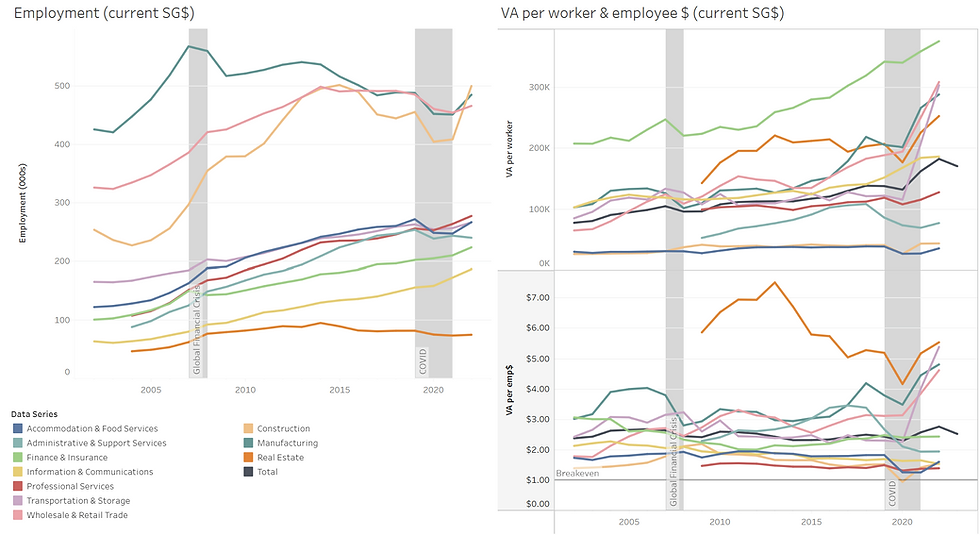
The headline finding: for most sectors, the amount of economic value generated per dollar spent on employees has been flat or declining since around 2008 — and has not meaningfully recovered even as employment numbers rebounded post-COVID.
To make this concrete: a business that spent $1 on an employee in 2008 was generating roughly $2.50–$3.50 in value added from that dollar. Today, in many sectors, that same dollar generates less. The gap hasn't closed — it has drifted the wrong way.
A few sectors stand out. Finance and Insurance has maintained strong VA per worker, which explains why those jobs remain well-compensated and in demand. Real Estate was a historical outlier — at times generating close to $7 of value per employee dollar — but that ratio has collapsed sharply. For the majority of sectors, including the Total economy line, the trend is unmistakable: flatter, and in some cases lower.
This is not a story about lazy workers or ungrateful graduates. It's a structural story about the economics of hiring in a high-cost city-state. When the value generated per dollar spent on people stagnates, businesses face a binary choice: find ways to do more with fewer people, or move operations somewhere the arithmetic works better.
This is why Asia Pacific Breweries, Yeo Hiap Seng and even H&M have shifted operations. It's why accounting firms and training companies have quietly moved most of their headcount to Kuala Lumpur. Not because Singapore workers are bad. But because the business case for hiring them at Singapore prices has become harder to make — and the data shows exactly why.Employment is not an entitlement. It is a contract. And contracts require both parties to find the terms agreeable.
The Real Shape of the Problem
Here's where it gets genuinely interesting — and where the Cynefin lens becomes most useful.
Our view is that the employment market has always been a Complicated problem — even before the current tensions. Think about what a hiring decision actually involves: every organisation has a unique context for why they need someone, and every candidate brings a different combination of skills, experience, and personality to the table. Somewhere in the space between those two things, both parties decide whether to proceed. There is no universal formula. There never was.
What the degree system — and Singapore's meritocracy framework in particular — did brilliantly was serve as a workable shortcut through that complexity. Singapore bet heavily on meritocracy as a national doctrine, and the closest measurable proxy for merit has always been grades and academic credentials. Most countries have some version of this system, but Singapore took it further and more seriously than almost anywhere else. For a long time, that was a smart bet. The correlation between academic performance and workplace capability was strong enough to make it a reliable hiring signal.
But correlation is not causation, and proxies eventually drift from what they're measuring. Recent shifts in the business landscape — rising costs, automation, globalisation of talent — have weakened that correlation faster than the system has adapted. And because Singapore leaned into meritocracy so fully, the reckoning may prove more jarring here than in countries where the degree was always treated as just one signal among many.
This is why the current moment feels so disorienting to so many graduates. They did everything the system asked of them. The system, it turns out, was measuring the wrong things — or at least, insufficient things — for the world that exists today.
The graduate-employment tension, then, has moved from Complicated into something messier: the domain Cynefin calls Complex, where causes and effects can only be understood in hindsight, where multiple factors interact in unpredictable ways, and where rigid solutions often make things worse.
Degrees, interviews, and probation periods were never perfect signals — they were just the best approximations available. What's changed is that those approximations are failing faster, and the conditions that made them work (stable industries, predictable job functions, long tenure) are eroding.
And then there's AI.
The Wildcard That Changes the Game
If the labour market has shifted from Complicated to Complex, AI is the force that threatens to push it further still — toward the Chaotic end of the spectrum, at least in the short term.
Chaotic, in Cynefin terms, means the old rules don't apply, cause and effect are unclear even in hindsight, and the right move is not to analyse your way to an answer but to act, observe, and adapt. That description fits the current AI moment well. The pace of change is fast enough that even careful analysis becomes outdated quickly, and anyone claiming to know exactly which jobs will survive is working from a map that may already be wrong.
AI has the potential to fundamentally reshape the value chain. Not just automate tasks — reshape the nature of what work is. As routine and digitised work becomes cheaper and faster to do with machines, organisations will need fewer people to achieve the same outputs. But they will need different people for the new tasks that emerge.
That said, we don't believe the chaos will be permanent. This has happened before — the personal computer didn't end employment, it ended certain jobs and created others. Over time, new norms formed and the labour market adapted. We expect the same arc with AI: a turbulent transition period where the rules feel unclear, followed by a gradual settling into a new normal as organisations, workers, and policymakers figure out how the pieces fit together.
The question is not whether the market will stabilise. It will. The question is whether you will have built the right capabilities to be valuable in the world that emerges on the other side.
The honest answer is that no one knows exactly which roles will survive, which will transform, and which will disappear. Anyone claiming certainty here is selling something. What we can say with confidence is this:
The candidate who offers a clear, demonstrable value proposition will always have more options than the candidate whose main pitch is a credential and a salary expectation.
What This Means for You
Whether you're a fresh graduate, a mid-career professional, or a business trying to build your team — here's the practical takeaway from this framework.
Stop optimising for the old map. The degree-to-job pipeline is not broken, but it is no longer sufficient. A qualification tells an employer what you studied. It doesn't tell them what you can do, what problems you can solve, or whether hiring you makes business sense.
Start thinking like a value proposition. No employer — none — can rationally turn down a candidate who clearly creates more value than they cost. The conversation shifts the moment you can articulate specifically how you will help an organisation make more money, save more money, manage risk better, or get things done faster. That's not arrogance. That's just good business thinking.
Build skills that compound. In a complex and potentially chaotic environment, the most resilient thing you can invest in is your ability to think through problems, make sense of messy data, and make sound decisions under uncertainty. These are the skills that survive automation — because they're the skills that automation cannot replicate.
And here's the thought that rarely makes it into these conversations: employment is one way to monetise your skills and time. It is not the only way.
The same value proposition thinking that makes you a stronger job candidate also applies to freelance consulting, building a side income, or creating a business around what you know. The VA-per-employee-dollar data tells us that organisations are under pressure to get more from every hiring dollar. But that same pressure creates space for individuals who can deliver outcomes without the overhead of full-time employment — the CPF contributions, the office space, the management bandwidth.
This isn't a call to abandon job-seeking. For most people, employment remains the most practical and stable path, especially early in a career. But thinking of a job as your only option is a holdover from the old Simple playbook. In a Complex world, building multiple ways to create and capture value is simply good risk management.
The recruiter who said Singaporeans aren't "hungry" enough may have expressed it clumsily — and the public backlash was predictable. But underneath the poor phrasing is a real question worth sitting with: What value am I bringing to the table, how am I delivering it, and is that value priced correctly?
That's not a comfortable question. But it's the right one.
The Bottom Line
The headlines about graduate unemployment, business relocations, and workforce attitudes are not three separate stories. They are one story, told from three angles, about a labour market that has moved from Simple to Complex — and is being pushed, by AI and geopolitical change, toward something even more uncertain.
The data confirms what many have sensed but struggled to articulate: the economics of employment in Singapore have shifted. Businesses are generating less value per employee dollar than they were fifteen years ago. That changes the hiring calculation — for individuals and organisations alike.
The old playbook — study, degree, job, career — served its purpose. But it was built for a world where the rules were stable and the cause-and-effect was predictable. That world is changing.
The professionals who will thrive in what comes next won't be the ones with the most impressive-sounding credentials. They'll be the ones who can demonstrate clear value, adapt to ambiguity, keep learning long after the graduation ceremony, and think creatively about the many different ways to put their skills to work.
Employment is still a valid path. But it is no longer the only one worth considering. That's not a crisis. That's an invitation to think differently.
We'd Love to Hear Your View
The labour market is shifting in ways that affect all of us — whether you're just starting out, mid-way through a career, or leading a team trying to figure out what the next few years look like.
We've shared our read of the situation. But this is genuinely a complex problem — in every sense of the word — and we don't think any single perspective has the full picture.
So we'd like to ask: where do you see yourself in this story? Do you think the old playbook still holds? Have you already started rewriting your own? Or are you somewhere in between — sensing that things have changed, but not yet sure what to do about it?
Leave a comment, or reach out directly. We read everything.
Curious about the data behind this article? The analysis of Singapore's value added per employee dollar — across ten sectors, spanning two decades — is available to explore interactively. View the underlying data by click on any of the charts in the article.
Want to build the skills to read trends like this yourself? This kind of analysis — connecting economic data to real-world decisions — is exactly what FYT's programmes are designed to teach. Not theory for its own sake, but practical tools for making sense of the world you actually work in. Explore our classes →


Comments